Showing posts with label animation. Show all posts

Friday, September 23, 2011


The Secret of Kells (2009)
IRELAND/ FRANCE/ BELGIUM --- animation/ fantasy

Dir: Tomm Moore

A group of talented animators presented this Oscar nominated animated fantasy film from Ireland, spotlighting the creation of the Book of Kells. The "Book of Kells" is basically an illustrated interrpretation (Insular Art) of the Four Gospels (Matthew, Mark, Luke, and St. John) from the Christian Bible. They are very old, dating back to the 8th century, and were painstakingly designed with various forms of ink, precious stones, and gold.

Though fictionalized, the film tells the story fairly close to the historical legend, being set in middle ages of Ireland, as our young protagonist, Brendan, is an apprentice in an Abbey. The monks regale young Brendan with tales of the "magical" book of Iona, as he wishes himself to be an illuminator. As the multi cultural group of monks await the arrival of a brother Aidan of the island Iona. He is an illuminator, who has constructed a book of kells called "The Book of Iona". When the island of Iona was attacked by a band of ravaging vikings, Aidan had to protect the book from being destroyed, and fled the island with his white cat Pangur Bán. Meanwhile, Brendan's uncle, Abbott Cellach, has put all effort into the building of a wall to protect the Kells from the inevitable invasion of the vikings. If you want to see a truly graphic form of these kinds of invasions, watch Andrei Tarkovsky's film "Andrei Rublev".

Upon Aidan's arrival (who looks like a cross between Willie Nelson and George Carlin), Brendan inquires him of the book of Iona. When Abbott Cellach spirits Aidan away to work on the wall, he's tasked with feeding Pangur Bán. Brendan, however, accidentally overhears Cellach and Aidan in a heated discussion about the wall, in which Aidan admits the best solution when the Vikings get there, is to run. Abbott Cellach is determined to stand by the fortified Kells, and leaves Aidan to his illuminating. When Aidan returns to the scriptorium, he tasks Brendan with finding gall nuts for ink in the wilderness. Brendan gladly takes Pangur Bán along on his search.

Arriving alone in the woods, he finds himself surrounded by wolves, and is soon rescued by a forest spirit. She appears first as a white wolf, then as young girl named Aisling (or Ashley). Brendan tells her he's only there to find these gall nuts for ink, and she makes a deal to show him where to find them if he promises to never return. He agrees, and she guides him to what he needs. Before leaving, he encounters the Celtic pagan deity Crom Cruach, which puts fear into even Aisling. When he returns to the scriptorium with brother Aidan, he finds that Abbott Cellach has learned of his disappearing into the forest and forbids him from leaving the confines of Abbey Kells. Even still, Aidan teaches Brendan illumination, and they continue to work on the book until they come to the Chi-Rho page. Aidan confides in Brendan he needs his help in doing this page as he's getting too old to construct it himself, and it can only be done through the use of a crystal.


He also tells him that the crystal was the eye of a pagan deity found in one of their caves. Brendan, having already found Crom Cruach assures Aidan he can get another crystal. In the meantime, we see that the vikings are certainly on their way. That night, Brendan sneaks out of the Abbey again, and meets Aisling in the forest. She pleads with him not to confront the deity, and reveals that it was Crom Cruach who destroyed her people. Brendan goes forth anyway, in what appears to be more of a spiritual battle against the deity for the crystal. This time when he returns to the Abbey, Abbott Cellach has locks Brendan up in a dungeon, and only Aisling can help him escape before the immenent vikings invade.

"The Secret of the Kells" is a visually arresting film, but the story leaves you with much to be desired. Gotta admit the animators missed the mark with the blatant Negro cariacture of one of the monks. I will give them a very slight advocation by the possibility they were simply ignorant of what offense this would take in other countries. I also note that in the special features, they show an early version of the character which is less abrasive, but whatever. The film is certainly not perfect. The direction wasn't the greatest, as the characters actions didn't always seem to match the vocal performance. Also, I'm still unsure how Brendan could tell Aisling that Crom Cruach was an imaginary pagan diety, but yet he claims she is one as well earlier.

Steeped in a profound religious tradition, but bathed in stunning visual delights, "The Secret of Kells" weaves a tale of both faith and Celtic mythology. Aidan's white cat with one eye green and the other blue is based on a real life cat named Pangur Bán (which is translated "whiter than white"; a Christian reference), of which a poem was written by an anonymous monk in the 9th century. Aisling and Crom Cruach are loosely based on Celtic mythological deities. Aisling is based on Tuatha Dé Danann translated as "peoples of the goddess Danu". The film is an interesting tame children's story, but lacks the deep insight or storytelling to keep the interest of the adult audience. I felt the ending left me hanging somewhat.

Friday, June 10, 2011


Tiě shàn gōngzhǔ (Princess Iron Fan) (1941)
CHINA --- fantasy


Dir: Wan Guchan, Wan Laiming

Every nation has their own famous fairy tales and legends passed down throughout time. These tales usually are held in high regard because of their connection to the national identity. "Journey to the West" is a classic of Chinese literature and has gone on to be a retold for each generation. "Princess Iron Fan" is one of the very first cinema adaptations of the tale and was produced in the midst of World War Two. Besides that, it was really one of the very first full-length Chinese animated films.

"Journey to the West" is a 16th century novel which was based partly on Siddhārtha Gautama (Buddha)'s flight to the west in search of himself, Buddhist monk Xuanzang, Taoist philosophy, and Chinese mythology. Being an amalgam of these, the tale, uses a group of four heroes who must make their way through a long pilgrimage through mountainous terrain to obtain the Buddhist scriptures.

"Princess Iron Fan" has an opening explanation about how the film is not to be viewed as a fairy tale, but a life lesson. The tale is about the fiery mountain blocking the path of Tang Seng and is to be seen as a metaphor for the difficulties we all find in life. Our four heroes are Tripitaka or Xuanzang (basically meant to be Buddha), Zhu Bajie (a pig), Sun Wukong (the monkey king), and Shā Wùjìng. During their journey through the fiery mountains, they must find a way to reduce the heat, with the help of the palm leaf fan. The magical iron palm leaf fan is in the possession of a princess who lives nearby with her husband the Bull Demon King. If they get the fan from the princess, they can use it to not only put out the fires, but bring rain upon the land.

In their first attempt to obtain the fan from the princess, Sun Wukong  creates a powerful gust with the fan and blows him away. He lands on a mountaintop monastery where he is given a wind pearl by a monk. The pearl will enable him to become unmovable by the force of the palm leaf fan. When the Monkey King returns, he is indeed invulnerable to the palm leaf fan, and is able to slip inside the princess' house by turning into a bug. When he gets inside, he lands on a tea cup and dives in. The princess, of course drinks the tea and a the bug straight down, allowing the Sun Wukong to threaten her from inside her stomach in order to get the fan. The Monkey King escapes with the fan. When the Monkey King returns to the fiery mountain and uses the fan, he discovers it a fake.

Zhu Bajie reluctantly offers to go find the Bull Demon King, who is a friend of his. In the next scene, we see a princess in another form, that of a fox creature. Anyone familiar with the Chinese myth of a Fox spirit will be familiar that this does not bode well (as opposed to the Japanese Fox spirit which is benevolent). Outside in the forest, she runs into Zhu Bajie, thinking he's her lover the Bull Demon King. She runs back to the Emerald Cave where she blames her husband for bullying her. Zhu Bajie gets to the cave and begs his old friend for the palm leaf fan, but he refuses, blaming Sun Wukong & Tang Seng for his son's death. Zhu Bajie then transforms into a frog and sneaks into the cave where he encounters a dragon. He transforms again, this time into the image of the Bull Demon King, and rides atop the dragon to get to the Palm Leaf cave himself. In the guise of the Bull Demon King, Zhu Bajie charms princess iron fan into giving him the palm leaf fan. He steals it from her, and gloats about him being able to fool her. On his way back to the fiery mountain, Zhu Bajie is also fooled by a dose of his own medicine, as the Bull Demon King transforms into the Monkey King and steals the palm leaf fan back from him. When Zhu Bajie returns to his companions empty handed, the travelers realize that the only way to defeat the Bull Demon King is their combined efforts in order to extinguish the flames of the fiery mountain.

"Princess Iron Fan" took three years to make by brothers Wan Guchan and Wan Laiming. Some things are confusing like the difference between the Bull Demon King's wives, and which exactly is the princess. There's even some mention of his infidelity, which is interesting. There's a very fluid movement of the characters which was achieved through rotoscope techniques, which was used most of the time in animated films of this era. The voice direction and camera movement is very off at times in this film, and sometimes you can't tell who is saying what. The film's score can also be distracting in most spots of the film, but has some interesting spots like a musical interlude complete with a sing-a-long bouncing ball over the lyrics. So the film is by no means perfect, but this is a historical achievement based on the fact it was made during the Japanese occupation of Shanghai. Though the film is directly inspired by "Journey to the West", it's also clearly influenced by the war, being the moutain as a metaphor for the Japanese.

Friday, February 18, 2011


Heavy Metal (1981)
CANADA
--- science fiction/ fantasy/ horror

Dir: Gerald Potterton

Fond memories of teenage years (though I wasn't one when this was released), "Heavy Metal" is a cult classic of the highest proportions. It is at once a collaborative, rebellious, raucous work of art toiled over a span of years and countries. For many an American GenX teenager, "Heavy Metal" holds an interesting fond place in our hearts. It was made in a time where animation was deliberately taking risks with more adult fare in cinemas like Ralph Bakshi's x-rated "Fritz the Cat", the dark age of Disney films, even "Transformers: The Movie" dared to kill off Optimus Prime.

National Lampoon magazine had bought North American distribution rights to a French magazine named Métal Hurlant ( translated roughly "screaming metal"). Renamed Heavy Metal, the magazine started in the 1970s and blended everything from dark fantasy, horror, science fiction, and oh yes erotica. Artists from all over the globe contributed their own stories and artwork such as H.R. Giger, Richard Corben, Moebius, and many many more. At this time, National Lampoon magazine saw the success on the big screen with a spinoff film "National Lampoon's Animal House" and it wasn't long before the idea to make a film based on Heavy Metal came to fruition. Produced by Canadian filmmaker Ivan Reitman, the film was to be animated by artists from France, Canada, the United States. The idea to make the film an anthology cemented the highly collaborative and unique hodgepodge style of Heavy Metal Magazine, as they adapt popular strips from that were featured in the magazine, as well as creating some new stories.

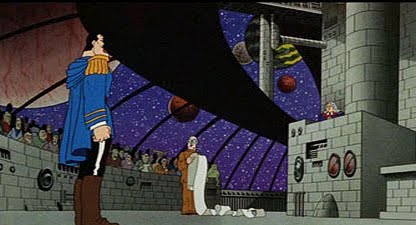
The title sequence opens with a story by late screenwriter Dan O'Bannon called "Soft Landing" which shows us an astronaut descending to earth in a 1960 corvette. This basically bridges the titles to the framing story of the film "Grimaldi", where we find the identity of the astronaut as Grimaldi coming home to his young daughter. He's also brought home a glowing green orb in a box. The orb ends up killing the Grimaldi as his daughter looks upon it in fear, just as the orb presents himself as "the sum of all evils." Called the Loc-Nar, the orb begins to show her the following tales in the film.


Based on Spanish artist Juan Giménez's "Harry Canyon", this vignette takes place in a dystopian New York City in the year 2031, focusing on the cynical taxicab driver, Canyon, who narrates. Inspired by a film noir, he reluctantly gets involved with the daughter of a scientist who has unearthed the mysterious Loc-Nar. When he is gunned down by a Casper Gutman-esque gangster, the girl is on the run and Canyon is in the wrong place at the right time. Helping her out, the daughter bargains with Canyon to give the Loc-Nar up to the gangster and split the spoils with him. In the end, Canyon realizes he should've never got involved in the first place. This piece has been highly influential, as you have seen many dystopian futurescapes since, in films such as "Blade Runner" or "The Fifth Element"; they have their genesis here.

The next segment (probably my favorite) is based on Richard Corben's popular strip "Den". Voiced by John Candy, nerdy teen Dan, finds the Loc-Nar and experiments with it for his own personal science project. During a lightning storm this inevitably teleports him to another dimension where he becomes a beefy bald grown man. Now as Den, he espies a group of cultists sacrifice a well-endowed young woman to a god called "Uhluhtc" ("Cthulhu" spelled backwards). After a safe rescue, she tells Den she's in reality Katherine Wells from the British colony of Gibraltar. Soon monster minions of Ard interrupt the couple's sexual acquaintanceship. They are brought to Ard, an effete immortal who puts Katherine in suspended animation and forces Den to steal the Loc-Nar from the Queen who tried to sacrifice Katherine in the first place. Den and Ard's beastly henchmen must infiltrate the Queen's palace and ultimately rescue Katherine. This is actually the second appearance of the character Den in animation. He originally appeared in a 1968 self-produced animated short called "Neverwhere" by creator Richard Corben himself. The backgrounds of this piece live up to the Corben art style, but the art (outside of the gratuitous nudity) don't capture Corben's thick pock oiled art much at all.

The next vignette is a comedic trip into outer space with Bernie Wrightson's classic ne'erdowell "Captain Sternn". We catch up to Lincoln F. Sternn on trial for a laundry list of violations against the law. Sternn insinuates that his attorney that he has an "angle". That angle turns out to be his witness for the defence, a scrawny guy named Hanover Fiste who soon transforms into a hulking brute who chases after Sternn. Turns out, in the end, Sternn really does have an angle. There was supposed to be a segment between this and the following one called "Neverwhereland" by animator Corny Cole which showed the Loc-nar landing on prehistoric earth and being responsible for all the evils throughout time. This was deleted for time management, but can be seen on the dvd.

"B-17" is basically a short EC Comics style horror tale involving a bomber pilot and his crew, when after perishing in a gun fight, suddenly become undead. This one was written by Dan O'Bannon and was originally to showcase a pilot against gremlins. The next segment is another comedic tale called "So Beautiful, So Dangerous" based on Angus McKie's story which first appeared in the October 1978 issue. This one is about an alien spacecraft abducting humans, and a very sentient robot putting the moves on a woman. This sequence is purely played for laughs before taking us into the final piece.

"Taarna" is an original story based loosely on French artist's Jean 'Moebius' Giraud comic strip "Arzach" which first showed up in the pages of Métal Hurlant in 1974. This tale begins with the Loc-Nar crashing into a volcano. The natives nearby are overcome by the Loc-Nar lava, but are mutated into vicious barbarians and as they go out to destroy a peaceful village. The village elders desperately seek their last refuge in summoning the lone survivor of a warrior race called, the Taarakians. They summon Taarna, a silent beautiful young woman equipped to avenge the peaceful race and seek out and destroy the ruthless mutants responsible. She heads out with her pterodactyl to the mountains to put an end to the mutants tyranny, and comes face to face with the source of the evil; the Loc-Nar. The film ultimately ties up with the revelation that this whole frame story with Grimaldi's daughter is tied to Taarna.

"Heavy Metal" is really an animated adult fantasy to end all adult fantasies. There really hasn't been any equal, and more than likely, will never be. Though a sequel was made years later, it still lacked the brash vision of this film. The fantastic score is provided by the legendary Elmer Bernstein, in what many of his fans proclaim is actually the absolute finest film score he ever did. The needle-dropped soundtrack is anything but in the genre of heavy metal, but peppered with soft rock and prog rock performers. The only real metal in the film is from Black Sabbath. Overseen by Ivan Reitman, you can see his influence throughout the film. Besides hiring composer, Elmer Bernstein, he made sure plenty of Second City performers got work in this. Not just in voice acting, but it almost seems the visuals were inspired by performers like Martin Short, Eugene Levy, and Harold Ramis. For further confirmation watch a double feature of this film and "Ghostbusters" back-to-back and view the similarities, especially in the climatic cityhall scene of GB and the press conference scene in the segment "So Beautiful, So Deadly". Currently, there is a live-action Métal Hurlant tv series airing in France apparently under the name "Metal Howling" or "Heavy Metal Chronicles". News also confirms that directors David Fincher, James Cameron, and Guillermo Del Toro plan to produce a new live action anthology film.

Saturday, November 14, 2009

Akira (1988)
JAPAN --- science fiction

Dir: Katsuhiro Ôtomo

After the so-called "Golden Age" of anime struck the U.S. in the 1960's through such television series as "Speed Racer", "Astro Boy", or "Kimba: The White Lion", the imports kinda slowed. Americans still received t.v. series, but we seldom got Japanese animated films. If we did get them, they were re-edited, renamed, and dubbed over to horrendous porportions such as Hayo Miyazaki's "Nausicaa".

When films like Akira (which I might add was much tamer than most stuff) came along in the late 1980's, they completely changed the landscape. Blockbuster Video actually made a section for their flood of Anime films and series being released on VHS. We were getting all the violence and sexually oriented fare that we just didn't get in the resurgent days of Disney-ized America. Film critics also took notice, and Akira was one of the hallmarks.
Based on his award-winning manga series of the same name, director Katsuhiro Otomo adapts his post-apocalyptic tale of a delinquent teen biker gang caught up in a government conspiracy of tampering with psychic research. The film takes place in the year 2019, thirty-one years after a nuclear explosion that causes World War 3. The motorcycle gang known as The Capsules, are in a gang war with a rival biker gang called The Clowns. During a high-speed brawl through the streets and on the highway, best friends Kaneda and Tetsuo get separated. Tetsuo, nearly runs down an elderly looking little boy, and crashes his bike. Surviving the accident, Tetsuo and the boy are spirited away by soldiers in a helicopter. The rest of the Capsules are arrested and taken in for questioning by local authorities.

Meanwhile, in a covert government facility, Tetsuo is found to be very special by a Colonel Shikishima and Dr. Onishi. He happens to possess extra-ordinary mental faculties, above and beyond ESP. They also happen to equate his power to another boy named Akira, who apparently had nearly omnipotent mind powers.
At the police station, Kaneda falls for a girl named Kei who is involved with the terrorist group. The two eventually strike up a friendship that leads to him uncovering what happened with his friend Tetsuo. Testsuo escapes from the government facility to see his girlfriend Kaori and steals Kaneda's bike as they plan to leave the city, but are ambushed by the Clowns, until Kaneda and the gang show up to rescue them. Tetsuo is captured once again by the government, and eventually begins to display and discover his new found powers, to which point he goes power mad. It leaves Kaneda in a situation where only he can attempt to rescue him.

Akira is a complex character study with visually arresting scenes. As an Anime film, it is one of the first more adult ones I've seen which left me with a feeling of something great just happened and I was too young to get it. Anime films have since followed in the tradition to keep up with the mature adult subject matter, even surpassing it in some instances. It, however, remains a visual masterpiece in animation.

Tuesday, June 9, 2009

STRINGS (2004)
DENMARK/ SWEDEN/ NORWAY/ UK
--- fantasy/animation

Dir: Anders Rønnow Klarlund


When it comes to fantasy epics put on film, they are few and far between. That’s because it is too costly, time consuming, and difficult for the filmmakers to idealize a fantasy world that is so far from reality that it’s hard to imagine.

Director Anders Rønnow Klarlund’s fantasy film, “Strings”, accomplishes this feat of epic storytelling. It captures the fantastical settings of films like Peter Jackson’s Lord of the Rings trilogy or the recent “Chronicles of Narnia” adaptation. The only difference here is every character in this film is a marionette. Furthermore, the characters know it. But unlike Gerry Anderson’s Thunderbirds or Team America, we see something here that is the true work of a gifted puppeteer, in a single frame we get emotion from a block of wood, and the expressions of the marionettes are not switched around or anything. It’s the magical collaboration of the cinematographer, the director, the voice actor, and the musician’s score. The art of the puppeteer dates back as early as the 16th Century and in many cultures of the world, but I don’t believe it’s ever been filmed successfully - until, perhaps, this movie.

“Strings” is said to be inspired by America’s decision to go to war with Iraq. Klarlund’s mythic fantasy tells the tale of Prince Hal Tara, heir to the throne of Hebalon, who’s King has just killed himself. No one in the kingdom however knows this. The King’s wicked brother, Nezo and his spidery henchman, Ghrak, concoct a machination that convinces the prince and princess, Jhinna, was murdered by the kingdoms sworn enemies the Zeriths. Once the prince is notified, all preparations are set for a vengeance quest, but the uncle, has already planned for him to never return and for himself to be ruler of Hebalon. But Hal’s journey leads him to some shocking discoveries about his father and his kingdom, and he ends up finding true love in the most unexpected of places.

The film is a beautiful masterpiece for what it really is; a bunch of puppets. Reminiscent of Jim Henson's "The Dark Crystal", it is also aesthetically charming, and profound of the portrayal of its universe. The marionettes live in a world where they are aware of their strings. They live in harmony with them. They even have a “life string”, that if cut they will die. The other thing is the puppets are given even more character, by how their strings look or how what kind of wood they’re made of. For instance the prince and princess appear to be gilded in gold and porcelain, and later we see the swamp-dwelling Zerith’s are made of driftwood. “Strings” stunning cinematography is gorgeous and all throughout the film never falters in this regard, be it capturing a snowbound mountain or a vast rainy night. This is a can’t miss film for animation and fantasy fans alike.

Monday, April 6, 2009


Kaze no tani no Naushika (Nausicaä of the Valley of the Wind) (1984)
JAPAN --- science fiction/animation

Dir: Hayao Miyazaki

An early Miyazaki directorial effort, he explores issues of paficism and an environmentalist stance that he would return to in some form or another throughout his career. This one being birthed from a serialized manga in a magazine run by producer/Studio Ghibli founder Toshio Suzuki . Kaze no tani no Naushika (Nausicaä of the Valley of the Wind) originally found its way to North American shores through distribution by New World Pictures under the title Warriors of the Wind; a severely cut version of the film.

In an indetermined future land, the earth is slowly succumbing to a fungal virus spreading across the world called the Sea of Decay. Nausicaä is a brazen young princess of the Valley of the Wind. She possesses the uncanny ability to communicate with all creatures of the land, including the gigantic insects that roam the earth. Some of these creatures are infected by the Sea of Decay.

With the assistance of a sage drifter called Lord Yupa, the peaceful seaside village of the Valley of the Wind must protect an ancient giant warrior embryo which was obtained by a flying ship which crash landed. Nausicaä must defend her land from a warring faction of Tolmekians who murdered her father and take her village hostage. They abduct her and force her to help resurrect the giant warrior to destroy the Sea of Decay and everything in it. Nausicaä reluctantly goes along until she can formulate a plot to stop the Tolmekian queen Kushana, to save the giant Ohmus from utter extermination.


A sort of sci-fi precursor or companion piece to fantasy Mononoke-hime (Princess Monokoe), Kaze no tani no Naushika (Nausicaä of the Valley of the Wind), Miyazaki seems incapable of making anything less than a masterpiece. As anime goes, the western world became enamored by Japan's no-holds-barred, provocative style of adult storytelling that wasn't specifically designed for children. Miyazaki has come along and actually showed us we can still talk to children without talking down to them. Kaze no tani no Naushika (Nausicaä of the Valley of the Wind), is another testament of Miyazaki's terrific style, with a blend of Jean "Moebius" Giraud style designs through a Frank Herbert storytelling scope, this is one early effort that's not to be dismissed or missed.

Wednesday, February 25, 2009

Paprika (2006)
JAPAN --- science fiction/animation

Dir: Satoshi Kon

Acclaimed Anime director dives into another psychological tale, this one a science fiction tale based on a novel from Japanese author Yasutaka Tsutsui. The film is based in the near future where a team of research psychologists/therapists are using an experimental device called the "DC Mini" that records dreams and allows the psychologists to enter patients dreams. One psychologist who has almost mastered this is Dr. Atsuko Chiba and her alter-ego "Paprika". She has been counseling Detective Toshimi Konakawa who has repressed memories that emerge in recurring enigmatic nightmares, in which "Paprika" assists in helping him come to conclusions of what they may mean, by actually showing him a replay of his exact dream.

However, being a device that has yet be approved by the government, the team find that one of their colleagues may be trapped in the device. They hold a meeting once they discover that three of the DC Mini prototypes has been stolen. Also, it seems that a contagious phenomenon has occured when one of the head scientists, Dr. Shima, on the project becomes susceptible to the someone else's dreams, causing him to leap from a building. He survives and realizes that a "dream parade" appeared in his dream, and is happening in reality. Thus opening an ethical discussion of whether or not the "DC Mini" should even be allowed to be used, when it could be misused in the wrong hands. The problem truly comes to ahead when they discover that the dreams are capable of entering the real world, and the wrong people really are in control of it.

This is an intriguing science fiction film. The idea of lucid dreaming (dreams in which you can learn to control) has been around for a very long time. Adding the element of a machine that can show the recorded dreams and play them back to you is great idea, albeit a bit scary notion on the same token. In fact I believe their are some real life companies hard at work on the idea. A new form of entertainment? Perhaps a little too personal at this point.