Showing posts with label UK. Show all posts

Friday, December 16, 2011


Excalibur (1981)
UK --- fantasy

Dir: John Boorman

This is, for me, the absolute quintessential film of any film dealing with Arthurian legend. Besides the fact it is almost strictly and painstakingly accurate to the source material of Sir Thomas Malory's "Le Morte d'Arthur", the very combination of Boorman's keen atmospheric attention to detail, sprint-paced editing, simplistic special effects, and the dedicated performances of Shakespearean trained thespians makes for an entertaining epic fantasy film. Coming on the heels of Hollywood's "Star Wars" mania, which sent producers in search of any and all science fiction and fantasy property they could get their hands on, the legend of King Arthur was bound for a serious special effects-laden film adaptation. In decades before, we had stuff like "Camelot", "Lancelot and Guinevere", and Disney's animated "The Sword in the Stone" (actually based on a book by T.H. White), but never an adaptation capable of effectively capturing the mysticism, beauty, and magic of the legend. Director John Boorman (Deliverance, Zardoz), set out to do just that.

Owing some inspiration to Roger Christian's now lost short film "Black Angel", Boorman set out to create an updated true-to-form Arthurian film directly based on Malory's epic tale. Shot entirely on location in Boorman's home of Ireland and utilizing the pick of the litter of both English and Irish film communities, "Excalibur" weaves the mythologic tale of Arthur Pendragon. In true fantasy tradition, it opens on the violence of his own father Uther (debut film role for Gabriel Byrne) in battle with a warring faction. In his possession is the legendary sword, Excalibur, but his use of it displeases the wizard Merlin (played by Nicol Williamson), whom it was gifted from. Uther was given the sword to form an alliance with Gorlois, Duke of Cornwall. However, Uther soon has designs on Gorlois' wife Ingrayne. He beseeches Merlin to have Ingrayne for his wife, using the Charm of Making spell, which would disguise Uther for a time as Gorlois in appearance. Merlin begrudgingly agrees under the condition that whatever becomes of his lustful affair would belong to him. What becomes of the affair is the boy child Arthur, in which Merlin soon after the birth comes to collect. Uther is angered and follows Merlin into the woods, but is ambushed and stabs the mystical sword of Excalibur into a rock. Merlin then proclaims the only one would will be able to release it will be the one to be king - it is only meant for Arthur.

Years later, when Arthur is but a squire, he comes across the sword himself. This after a tourney between several knights vying to pull the sword from it's enchanted locked state. When his knights sword comes up missing, the boy Arthur easily pulls the sword out to replace his knights. Merlin, then appears to them to tell all who witnessed that the boy is to be the king as he promised. Arthur's first action as leader is to rescue Leondegrance's (Guenevere's father) castle from an invading seige. After leading a successful attack against the invaders, they too join the boy king as he sets the stage for his knights of the round. Arthur takes Guenevere as a wife and celebrates with his knights. First, however, he must get one more respectable gifted knight on his side, Lancelot, who has beaten most all of the knights in his army. In fact, in a one-on-one battle, he is only able to defeat Lancelot with the power of Excalibur, and even going so far as to misuse the weapon causing it to break in two. The lady of the lake restores Arthur the enchanted sword and Lancelot gladly joins his army as Arthur's trusted second in command.

All is well, in the newly founded Camelot, so Merlin sees his fate to step into the shadows and allow the lot of man to fall where it may. However, he espies deception and ruin on the horizon as Morganna Le Fay (played by Helen Mirren), Arthur's half-sister, begins to have designs on Merlin's power with her own selfish ambitions. She soon enacts her own plot to uncover the affair between Lancelot and Guenevere, trap Merlin, and seduce Arthur to give birth to her own child for the throne. Before long, Arthur realizes the only way to restore life to himself and the kingdom is to find the Holy Grail. He sends his knights out in search of the Grail, and some of the knights fall victim to the son of enchantress Morganna, Modred (wearing a "Zardoz" mask?). Perceval too succumbs to the wiles of Morganna's trap, but is the one knight to escape and finally reach the Holy Grail, realizing that Arthur and the land are one. He returns to Arthur with the Grail and life is restored to the land, as Arthur prepares one final battle with his own "sinful" illegitimate son, Modred.

King Arthur has always been an allegory of both King David and of course Jesus Christ and his disciples. Having been written in the time of the Crusades, it very easy to see the influence and of course the very fact that the characters too search for the Holy Grail. Even though this is a mythic Dark Ages, the film's setting comes off the heels of the Crusades and the hope of a future in the Lord. The Christian symbolism is everywhere from the idea that the "king" is the land and the land is the "king", representing spiritual Jerusalem, to the visual cues of Perceval submerged/ baptised in water to find the Grail.

Can you imagine a "Lord of the Rings" film like this? Well, this film had it's origin somewhat in that when the studio at the time (United Artists) wanted Boorman to helm an adaptation of that. Luckily, Boorman stuck to his guns for a 3 hour epic film in the script stages, chronicling Merlin, King Arthur, and the Knights of the Round Table. Though the only versions out there are a 140 minute R-rated cut and a 119 minute PG-rated cut, apparently Boorman did shoot 3 hours of footage but the rest are deleted scenes properly awaiting arrival of a possible Blu-ray director's cut or something. The sets, however, were designed to with "Lord of the Rings" as inspiration.
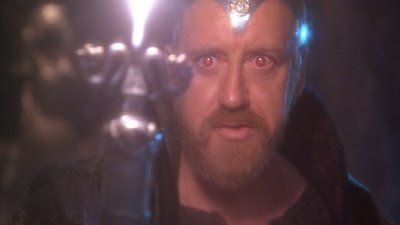


Though I feel Boorman should have consulted the guys at ILM or other special effects wizards at the time to accentuate the mysticism in the film, he did a good credible job. He took certain liberties that the passerby Arthurian fan would not notice anyway, yet for the world of the film they are accepted only in the fact that the story is told so concisely well. Nigel Terry should be commended for playing both the adolescent and adult Arthur with success and believability in both stages. A rare feat that I have ever seen in cinema. Nicol Williamson's Merlin is interesting to watch as he goes a little too schizo in scenes. I'm sure he was trying to stay away from being too "Obi-Wan Kenobi", but his character could have used more grounding. The costuming is perfect, and the production design is excellent throughout. "Excalibur" also features the epic sweeping score of composer Trevor Jones and spotlight's Wagner's original classical pieces as well. If you have to see one Arthurian film, start here as anything else is pretty much bland compared to this one.

Friday, November 25, 2011


Time Bandits (1980)
UK --- fantasy


Dir: Terry Gilliam


This is one of my top 5 all-time favorite films. I have fond memories of watching this in the theaters, the holiday season of 1981. I was the perfect age to watch a movie like this, a children's film that didn't quite speak down to its intended audience, yet could totally entertain the adult. I'm amazed at how it stands up, and how much more I see in it as an adult, something only the Looney Tunes cartoons did for me. The film that probably gave Terry Gilliam more leeway into Hollywood, with cementing his rather odd cartoonish style of film making, "Time Bandits", was a welcome addition in a time replete of science fiction and fantasy movies. Hollywood was surfing on "Star Wars" mania, and churning out any and every kind of potential film of the ilk, including "Conan the Barbarian", "Blade Runner", "Tron", "E.T.: The Extra-Terrestrial", "The Road Warrior", "Escape From New York", et cetera. Yeah, "Time Bandits" could have easily gotten lost in that shuffle, had it not been so unique and came as the first in a string of Gilliam favorites.


For me "Time Bandits" is simply about the unlimited imagination of a child's mind. It is a snapshot taken from a child's perspective, from beginning to end. Though Gilliam very clearly paints his films with precision, this one is DaVinci using crayons. As Gilliam is stated to having based it on an idea about thieves who rob stuff from the past and take it to the future. The very fact it's a time travel film loosened from the confines of strict scientific rules is just refreshing as all get out. It shares in part of the films appeal, I believe. Python alum Michael Palin returns to acting duty and also helped sculpt the script. Essentially, the film is about a young boy named Kevin, who is neglected by couch potato parents who seem to barely acknowledge his existence. Kevin however, is a very imaginative kid, based simply on what's in his room.


At first, he imagines a shining knight on horse back galloping out of his closet and straight through his bedroom, or what becomes a forest and his bed in it. The very next night, Kevin awaits whatever else could possibly emerge from the wardrobe, and he is barraged by a group of midgets who appear right out of his own closet. They at first mistake him, and his glaring flashlight, for someone else, someone important. That is until they realize, he's not who they thought. They go after him and quickly realize he's just a boy, and in the scuffle happen to push one of the walls of his bedroom out. Just in time too, as the one they mistake him for, the Supreme Being, comes looking for them demanding the return of his time map. Kevin runs along with them in his bathrobe (a homage to "Hitch hiker's Guide to the Galaxy"?), and they fall into the time hole taking them to the time of the French revolution. They quickly happen upon Napoleon (played by great genre actor Ian Holm) himself, and mistaken for a troupe of performers. Napoleon is enamored with people shorter than himself, and befriends them, while the gang steal him blind. While the gang make off with the loot, they find the time portal to medieval times, and run into none-other-than some of Robin Hood's Merry Men. Meanwhile, Kevin begins to become none-too impressed with the gang of incredulous little people and their self-proposed leader Randall. Hood (played excellently by John Cleese) of course, secures their stolen goods for himself to distribute to the poor.


At this point, their arch-nemesis, Evil Genius (Utilizing Sam Peckinpah alum David Warner at his high-browed Brit-accented evil best), is seen watching the diminutive gang quarrel among themselves over the map, an item he covets for himself. Confined to the Fortress of Ultimate Darkness, Evil Genius seizes an opportunity to get them to his own location, so he can obtain the map for himself. He hypnotizes one of the gang, namely Og, to convince the gang that within the Fortress of Ultimate Darkness lies "The most fabulous object in the world". However, the Supreme Being makes another appearance beseeching them for the return of the map. They find not one, but two time portals open up at the same time, and Kevin goes in the wrong one, sending him to back to ancient Greece. Now separated from the time bandits, he comes across the mythological King Agamemnon (played by Sean Connery), whom he quickly befriends as a father figure. Before long, though, the time bandits do catch up with him determined to spirit him away on their next journey, much to the reluctantance of Kevin. They end up on the SS Titanic (of course THAT Titanic),where Randall explains to Kevin his desire to seek out the Fortress of Ultimate Darkness for the aforementioned object. The problem lies in the fact the Fortress is not located on the map. When the Titanic sinks and the gang is out on the ocean, Randall surmises the only way to reach it is to simply believe, and sure enough a whirlpool opens (caused by Evil Genius) sending them into the time of legends where they come upon giants, trolls, and eventually the Fortress of Ultimate Darkness. The confrontation between Kevin and the time bandits ends up with them losing the map to Evil Genius, and needing to relie on their wits to escape the clutches of Evil.


"Time Bandits", in my opinion, is the film that probably put Terry Gilliam (pardon the pun) on the map. He cemented his visual style of low camera angles, shot in wide screen, multiple celebrity appearances, and a protagonist that the viewer may not feel all that comfortable in trusting by the time the credits roll. Though Gilliam would return to the sub genre of time travel with 1995's "Twelve Monkey's" starring Bruce Willis and Brad Pitt, this film didn't quite take the scientific aspect so serious. It even features ex-Beatle, George Harrison's theme song on the end credits, which has his usual catchy guitar riffs and some interesting lyrics if you pay attention.


Gilliam has since claimed "Time Bandits" as the first in his trilogy of ages as "Time Bandits" is about childhood, "Brazil" is about middle-aged, and "The Adventures of Baron Munchhausen" is about old age. For me, one of the little enjoyable little tidbits I noticed about the film is David Warner. An actor who, back then was taking many villainous roles just because. I had first seen him in this film. Later on, I had seen him in "Time After Time" when it aired on television, and then of course "Tron". What's significant about these roles is he went from playing Jack the Ripper in "Time After Time" which resulted in him being stuck in "infinity", then going to play Evil Genius in "Time Bandits", in which his character states at one point the need to master computers, in which he will in "Tron" as Dillinger/ Master Controller. Hmmmm. Yeah, I leave it up to interpretation. Taking cues from legends, myths, fairy tales, and children's literature, Terry Gilliam evokes everything from "The Lion, The Witch, and The Wardrobe", "The Wizard of Oz", and "Alice in Wonderland". With all that added there are full touches of humor that can be enjoyed by the child and the adult, and a non-scientific, care-free journey throughout time, "Time Bandits" is an enjoyable family film.

Friday, July 29, 2011


The Innocents (1961)
UK --- horror

Dir: Jack Clayton

Quite possibly one of the greatest ghost stories on film. I first encounterered this one, when I recorded this movie several years ago off of FOX MOVIE CHANNEL during one of their Halloween marathons. I waited a little later one evening to actually watch it fully, and it spooked the heck out of me. The images still haunt me, and the ending left me with a feeling that most great films leave me with, one of  "what-did-I-just-see-here?". That's impressive, because you're not going to watch too many horror films that make you think afterwards. At the end of "The Innocents", you are left wondering if it was ever really a horror film at all.

Based on both the 1898 horror novella "The Turn of the Screw" by Henry James and William Archibald's stage adaptation, "The Innocents" opens quite eerie with a young girl singing a moribund children's song "O'Willow Waly" over a pitch black screen, ambiguously setting the tone of the film. The credit sequence features Deborah Kerr (our Ms. Giddens) in prayer as we go into the her recounting the events of the film. A wealthy bachelor (played by Michael Redgrave) interviews Ms.Giddens as governess over his neice and nephew, Miles and Flora, in an isolated country estate. He demands she be fully independent and trusts her with full authority over the dealings with the children with the assistance of a kinda dotty housekeeper, Mrs. Grose. She accepts the job and is whisked away to the estate where she meets Flora playing outside by herself. Ms. Giddens soon befriends Mrs. Grose, but as they converse, revelations about the children and the past goings-on in the house come to light. Flora begins to rejoice in her brother Miles, coming home from school, even though the school term is still in session.

Soon, Ms. Giddens learns from a letter that Miles has been expelled from his school, and is expected to return home. When Miles (Martin Stephens of "Village of the Damned") arrives, things really begin to heat up for Ms. Giddens, as the supernatural paranoia in the home rises. Ms. Giddens soon claims to see a man and a woman around the estate. She's informed from photographs left behind the house that it's the old caretaker Peter Quint, and the woman is probably Ms. Jessel, the previous governness. Ms. Giddens learns that both Quint and Jessel died in or around the house. Both of them were very attached to the children as well. So, Ms. Giddens concludes that through careful observation of the children's peculiarly advanced behavior, that they either know about the ghosts of Quint and Jessel or are somehow possessed by their spirits. Curiously, her apparition sightings increase. Finally she confides in Mrs. Grose that she has seen the ghosts, and when Grose reveals that the two were in a torrid love affair, Ms. Giddens confronts the children on what they may have seen around the house. Unfortunately, her inference brings her to the absolute brink of obsession over what is truth and what is reality.

"The Innocents" belongs in that kinda rare little subgenre of the ghost story, belonging to not only a haunted house film, but one involving a woman alone (or just in confronted) in a haunted house. I can't begin to find the origin of this, my first inkling is something like the fairy tale "Blue Beard" or any of them, really, that involve a little girl lost in the woods. This kind of film serves as a psychological character study. The film dredges up issues like Ms. Giddens repressed sexuality being a cause of her possible delusions. Nuances like Flora correcting herself during prayer, or Miles' ever-so-longingly seductive kiss on the lips to Ms. Giddens, make for the entire film to be wrapped in ambiguity; and it never misses a beat. We must always remember we are watching a first person perspective flashback of events that happened, which in hindsight can shed light on the film's narrative.


Deborah Kerr does an excellent job in this film, and is one of her best performances. Also, the young Martin Stephens is incredible for a child actor, who does a 180 degree performance from his "Village of the Damned" role playing lead alien David. Like most great horror films, this one utilizes sight and sound to mass effect, including a running theme of chirping birds, creepy statues, and deep focus widescreen shots that always allows the audience to check the background for something or someone that seems out of place. The score provided by George Auric is subtle and eerie, and it comes to no surprise he also worked on "Dead of Night". Also, Hammer horror vet Freddie Francis composes the gothic noir-esque cinematography, with deep blacks and appropriate blinding light when needed. A prequel of the story was made in 1971 called "The Nightcomers" starring Marlon Brando as Peter Quint.

Friday, July 15, 2011


The Hitch Hiker’s Guide To The Galaxy (1981)
UK --- science fiction

Dir: Alan J.W. Bell

In the beginning, God created the heavens and the earth. Many many many many years later, he created a man who would be named Douglas Adams, who in turn would create a radio program he would title, “The Hitchhiker’s Guide the Galaxy”. Adams was a sort of lost member of the Monty Python comedy troupe who finally found success with the writing of the six-part radio show for BBC Radio 4 in the spring of 1978. The radio series became a cult hit and eventually was made into records, books, stage plays, and of course a theatrical film. Before the film though, there was this BBC produced miniseries adaptation, which I originally remember as a child from the heyday of PBS, which had brought me Sesame Street and Doctor Who among other things.

 For anyone not in the know, the story revolves primarily around a contemporary mild-mannered British man named Arthur Dent, who one day tries to save his house from being bulldozed by the city for the building of a highway. The only problem is it won’t matter, because as his friend Ford Prefect comes to tell him, the world will soon come to an end. A race of aliens named Vogons, have a constructor fleet also coincidentally about to destroy the earth to make way for an intergalactic highway. Dressed only in pajamas and a robe, Dent is whisked away from the earth by his friend Prefect as they literally hitch hike across the galaxy. As it turns out, Prefect reveals he’s an alien stuck on earth for the last 15 years. He’s been here researching the planet for the electronic book known as “The Hitch Hiker’s Guide to the Galaxy” for a new edition including an update on Earth (which turns out is not just “harmless” but “mostly harmless”). The duo gets into a series of hilarious adventures and misadventures that involve everything from torture by listening to Vogon poetry (only the third worse in the galaxy according to H2G2), to a manic depressive robot named Marvin, and even the mind-boggling answer to the 7.5 million old question of Life, the Universe, and Everything.

High on satire, the miniseries stuck to Douglas Adams’ wry British humor when it aired in 1981 and even used original cast members from the radio show including Peter Jones (as the narrator and voice of the book), Simon Jones (as Arthur Dent), Mark Wing-Davey (as Zaphod), and a few others. Some diehard fans of course complained about its not keeping the spirit of the books, but this miniseries predates the books. Some people completely are oblivious of the original radio show too. It also brought a unique addition to the story by successfully visualizing the narration and Adams sense of humor through Rod Lords’ animation sequences. Shot on 16mm, and suffering from cheap special effects like the nearly inanimate second head of Prefects second cousin Zaphod Beeblebrox. This version however keeps to Adams keen, often brutally honest reflection of the human race, as he oversaw the production from start to finish.

I have not seen the 2005 feature film with Mos Def, but I have always wanted a film directed by Terry Gilliam and starring some of the Python troupe. I suspect the Python guys respected their friend Adams’ work, but weren’t that into it. I don’t know what Gilliam ever thought of it, but of course I don’t think he could direct something where his imagination was restricted. Still it might be interesting to see. Anyone who’s a fan of British sci-fi like "Dr. Who" or "Blake’s Seven" should definitely consider the original miniseries of “The Hitch Hiker’s Guide to the Galaxy” a must see.

Friday, June 3, 2011


Zardoz (1974)
UK --- science fiction / fantasy


Dir: John Boorman

The science fiction films of the 60's and 70's were all quite boring. Though they had great aestethic and often strong original introspective messages about . . . whatever, they often lacked the maschismo and child-like fun that later came in the wake of George Lucas' Star Wars movies. John Boorman's "Zardoz" is no exception from this trend. Made immediately after his controversial hicksploitation hit "Deliverance", Boorman delved into this more thought-provoking sci-fi adventure in a futuristic setting. Though the results are very mixed to say the least. "Zardoz" opens with a prologue of sorts of the floating head of a man named Arthur Frayn, who claims to be the titular character. With a penciled in mustache and beard, he proclaims to be immortal. We then see the beautiful mountains and a giant hovering sculpture-like head who is the god of a people called Exterminators, who are charged to kill the Brutals. They are a group of Anglo-Saxon men dressed only in orange straps and adorned with two-sided masks with the very same visage of Zardoz. From the head giant floating head, comes the voice of Zardoz who commands them to kill and to abstain from sex, and soon it emits guns and bullets.

Set in the year 2293, Sean Connery stars as one of these Exterminators, named Zed. He arises from some grain within the stone head, where he finds Arthur Frayn and shoots him dead. The stone head lands and Zed leaves searching his new surroundings. Zed stumbles upon Arthur Frayn's home, Vortex 4, where he finds a ring with images of Arthur and a computerized voice emaniting from it. He is soon found by a woman named May (Sara Kesteleman) who wishes to learn how he came to get inside the stone head. He claims to not remember, and he soon ends up on a table being mentally probed by May and another 'Eternal' woman named Consuella (Charlotte Rampling). We learn that Zed is basically a lower lifeform, and that those who live in the vortex are higher species called homo eternals. They are also a matrichal society where the women have more say than men, and while they all possess a psychic power and an erudite mentality, they lack many things. May takes on the task of keeping the Zed for scientific experimentation, while Consuella strongly adheres to its presence in the vortex. Zed, however gets a male guide through the vortex named Friend. Sarcastically calling him monster, Friend shows Zed that even their utopian society has its class system. He shows him the different parts of the Vortex, including the apethetic women devoid of feeling and the renegades, who much like Jonathan Swift's immortal struldbrug's grow ever older but never die, as a punishment. It's clear that Friend is becoming unhinged by the appearance of Zed, as he despises his own immortality and the female dominant society. Bringing a raw machoismo, Friend becomes envious of Zed's lack of not only immortality, but of a sensual freedom. The matrichial society is disturbed by Zed's presence, but Friend is more ambiguously inspired.

Both Friend and May defend Zed's presence in the Vortex as scientific research. However, Friend's impure thoughts and rebellious behavior lead him to being ostracized from the Vortex and marked a 'Renegade', to which the left side of him ages rapidly. May continues to probe Zed to find out what happened to Arthur Frayn. She eventually finds that he murdered Frayn, and that Frayn allowed him into the secret of how the outlands came to be. Frayn, however, is not dead, but has been regenerated and reveals that Zed is actually a superior "Brutal" through Frayn's eugnenics experimentation. It is also revealed through May's probing that Zed has learned the truth of the his god "Zardoz", being named after the L. Frank Baum book "The Wonderful WiZARD of OZ".

Confused? I won't ruin the ending, if you can call it an ending. Though the film is strange a little too heavy on its preaching and gratuitious nudity, it is a cult classic. "Zardoz", as Boorman admits on his dvd commentary, was much more ambitious than the budget allowed. The message was and is also lost. Though the film is an original piece, it features a hodgepodge of different myth references, but it's all too cerebral to catch in this package. The idea of genetic engineering was clearly ahead of its time. "Zardoz" is unique, as it is one of the very few scifi films you find an actual working utopia. However, as many utopian fiction, that is quickly unmasked as a dystopia.


Friday, May 13, 2011


Village of the Damned (1960)
UK --- science fiction/ horror

Dir: Wolf Rilla

Just what is it with cinema’s long sad history of antagonizing young children? Maybe it’s because we see them as so innocent, no wrong can be done from their precious little minds. Or perhaps there is a deep dark fear that with everything our forefathers and we have built and strived to create in our world, the next generation could easily rip down everything and destroy it.


Somewhere around the mid 1950's and on into the present, there has been a quaint little sub-genre of horror cinema that specifically involves evil children. I'm not sure anyone has pin-pointed when it started, but I would suggest it began with the 1956 Leroy Mervyn film "The Bad Seed". Along with that movie, "Village of the Damned" appears to be a post-World War II commentary on what exactly lies in the future minds of our youth. It's apparent to note other films of a similar ilk like "Blackboard Jungle", "The Wild One" and "Rebel Without a Cause" which focused more specifically with rebellious teenagers. But I digress, this "evil children" phenomenon seemed to deal specifically with the unnerving feeling of having birthed an almost demonic force that adults fear. Television even picked up on this when "The Twilight Zone" adapted Jerome Bixby's tale "It's A Good Life" to the airwaves. So there is definitely something to this. I suppose one can simply find the origin of this in a reversal of the immaculate conception of Jesus Christ. Instead, of course this is probably pointing to (as the film "The Omen" did) specifically the anti-Christ.

Based on science fiction novelist John Wyndam's 1957 novel "The Midwich Cuckoos", the film "Village of the Damned" weaves a terrifying tale of a town that is slowly destroyed from within, by a new found breed of peculiar children. When Maj. Alan Bernard (Michael Gwynn of "Revenge of Frankenstein") places a phone call to his brother-in-law Professor Gordon Zellaby (George Sanders), he loses him. We see him and everyone else in the small town of Midwich pass out. We then see that it's not just him, but the entire town including animals has passed out. For several hours the residents of Midwich are secluded within a mysterious "time out", that has no scientific explanation.

Upon investigation, Maj. Bernard finds that it is only the town from a certain perimeter that has experienced this phenomenon. They set up a quarantine around the town with the town doctor standing by to discern just what has happened. With no real signs of anything malignant, everyone eventually does awaken. Professor Zellaby and his wife wake up hours later with odd effects such as a chill and numbness. However, not too long later, all the women of  child-bearing age who experienced the "time-out" discover that they are mysteriously pregnant, including Mrs. Zellaby. The doctor and town parishioner find that they have no explanation whatsoever for this event. When the children come on the scene, the townsfolk realize they are all related by strange eyes, platinum blonder hair, an apathetic demeanor, a shared high intellect, and most of all they exhibit the capacity for Extrasensory Perception and even mind control.

At the rapid pace of these children's aging, Professor Zellaby, the town doctor, and Maj. Bernard realize they may need to study these children more closely. In a meeting with some scientific minds and the military, they also learn that the same "time-out" occurred in other countries, including the Soviet Union, Australia, and an Inuit tribe in Canada which killed their children. With the exception of the Soviet Union who were training their children, most of the other children did not survive, which leads Zellaby to a sympathetic stance, feeling there could be unexplored assets to studying them further. He bargains with this small council to keep them under close watch for one year under his watch. They all agree, and thus trouble begins.

The Zellaby child, David, seems to position himself as the ringleader of the children, which makes the Professor even more eager to explore their prowess. However, when they begin to kill some of the villagers out of self-defense and then just plain old eliminating anyone of a threat, things become more hairy. When news comes that the Soviets destroyed their children in one village like Hiroshima, the Professor has become aware that drastic actions must be taken one way or another.

"Village of the Damned" is an excellent science fiction film. Unfortunately, over the years it has, as mentioned, turned into a horror cliche, and all remnants of sci-fi are gone. In fact the only mention of aliens is in one scene in the film. Clocks figure prominently in the theme of "Village of the Damned" appropriately. The novel is called "The Midwich Cuckoos", as in the cuckoo bird which we associate with the cuckoo clock. However, the title is insinuating more than that, as the nature of the cuckoo bird is to lay its eggs in the nest of another birds species. The mother will feed the the young cuckoo birds unbeknownst of their lineage. Interestingly, the spooky eyes used in the film, look strikingly similar to the cuckoo birds eyes.

There was a remake of the film in 1995 by horror master John Carpenter. The film transported Midwich to New England, America, and concentrated more on the horror aspect of the story, and threw in a government conspiracy. In fact the only mention of extraterrestrial possibility is in a classroom scene in the original film where Professor Zellaby asked the children about life on other planets. The idea of abortion was brought up in this version of the film, which is interesting since the original film sparked controversy from Catholic anti-abortion groups, even though there was no mention or hints about the subject. "Village of the Damned" is a classic science fiction film that goes beyond the Cold War nightmares of science gone wrong, and hits more at the heart of our own psyche. As opposed to nuclear threats, there's the threat of the minds behind those who could potentially hit that button in the first place. The look of the children is a clear homage to Hitler's ideologies of an Aryan Übermensch (translated "Super Man"). The Nazis actually recruited Aryan women for a program called Lebensborn and impregnated them for this purpose. They also kidnapped thousands of blonde-haired blue-eyed children. It's safe to say, John Wyndam was definitely inspired by these true events when putting "The Midwich Cuckoos" to paper.

Saturday, April 9, 2011


Beowulf & Grendel (2005)

CANADA/ ICELAND/ UK --- fantasy


Dir: Sturla Gunnarsson


The battle between good and evil has been mulled over in myth, legend, religion, and history since before man could formulate a language. The tales of heroes have always found their place in our hearts and minds, and the ancient epic poem of "Beowulf" has had its lasting appeal for that very reason. In this loose adaptation of the poem, director Sturla Gunnarsson does a highly impressive attempt at retelling the legend.


"Beowulf & Grendel" opens with a segment of the poem and almost immediately, the film deviates from it by showing us the grendel's father (a character made up for the film). The scene depicts Hroðgar (or Hrothgar in this film), the king of Daneland, in his youth with a bunch of his soldiers chasing and killing the elder grendel on a mountaintop. However, Horothgar allows the young grendel to live, a mistake he will live to regret. When the soldiers leave, the boy grendel goes to the beach shore, where his father's body lain. Pining for his father, he takes a keepsake; his father's head.


Fast forward years later, we see the adult grendel in a cave with the mummified skull of his father. He beats himself upon the head with stones in a rage, clearly in a fit stirring vengeance against his father's murderers. We see that the grendel espies the warriors camp, and plots his violent one man war against them. The grendel kills twelve of Hrothgar's soldiers one night. We are next introduced to Beowulf, who arrives on the shores of Geatland after being shipwrecked out on the sea. Beowulf gathers a group of Geat soldiers to visit his kin, King Hrothgar, who they have heard is in peril with a troll. When Beowulf arrives to the shores of Denmark, he comes across the seahag first, in the ocean. Then he consults with the hermit witch Selma (Canadian actress Sarah Polley), who begins to help him unravel the mystery of the troll's campaign of bloody vengeance. This is another newly invented character to serve the films updated version of the tale. Soon, Beowulf begins to understand that his perspective in this little skirmage must change in order to defeat the creature on his turf. After some revelations about the grendel fathering a child from the witch Selma, who of course sleeps with Beowulf too, the deviations of the film turn confusing. The addition of the new characters are clearly not needed, and though they do bring some character development to the grendel.


The final battle with Beowulf and the Sea Hag is over way too quick. The performances are well done throughout "Beowulf & Grendel". Gerard Butler is here to fill the stoic hero role and does as well as he can, but not as good as he is in "300". Swedish actor Stellan Skarsgård chews the scenery with relish, and that's not a bad thing as he puts in a brilliant portrayal as the fraught stricken King Hrothgar. Polley puts in a competent performance, but of course she's just a little too Western for the film in my opinion. Kudos to Iceland actor Ingvar Eggert Sigurðsson for a down to earth performance as the other titular character. He plays the role with enough pathos and genuine primal nuance, you almost believe it's not a man. Gunnarson has a strikingly atmospheric direction. He has properly captured the cold yet beautiful landscape of the Iceland, which seems untouched by time. The major glaring mistake of this film is the use of curse words. It definitely feels completely out of place for these characters to be dropping the "F" bomb every couple of minutes. They could have used better make-up effects on the grendel. Albeit, the prosthetic effects they do use is very believable, and showing the monster in the beginning of the film prepares the audience for a credible version of the tale. Apparently they wanted to portray the grendel as more of a Sasquatch than a troll.

Friday, March 18, 2011


Jabberwocky (1977)
UK
--- fantasy

Dir: Terry Gilliam

After his years being a part of the Monty Python troupe, Terry Gilliam took his first foray into solo film making. Having come from an animation background and co-directing some of the early Monty Python feature films with fellow alumni Terry Jones, he was well prepared. The evidence of things to come is here in the film "Jabberwocky". Gilliam pokes fun at the "dark ages" through the use of Lewis Carroll's nonsense poem "The Jabberwocky" from the book "Alice Through the Looking Glass".


The film opens a lot like a horror film, with a poacher (Terry Jones) in the woods stalked and killed by the Jabberwocky. We then follow our hapless hero Dennis Cooper (played by Python's go-to leading man Michael Palin), the son of a barrel maker, who instead aspires to be a stock taker. When his father passes away, practically cursing Dennis with his last breath, he goes off to the city for work. Before he leaves home, he stops to assure his fair love, a very crude rubenesque girl named Griselda Fishfinger and her uncouth family, that he will return to take her in marriage. With that, Dennis is off to find employment.

We next see the king in his bedchambers, and as Gilliam and the Python troupe are notorious for, they show the quite unsightly shady side of the powers that be to comedic and absurd effect. Though done in this very Brit humour style, it still rings all too true. King Bruno the Questionable, son of Olaf the Loud, et cetra, must not only contend with the common folks pining for food and work, but for the fear of a ravaging monster stalking the countryside. His chamberlain, Passelewe, suggest a tournament to the death for the hero to be tasked in finding a killing the monster. He goes to tell the princess with his plan to give her over in marriage to the champion. Meanwhile, Dennis can't even enter the city. Left out in the cold, rainy outskirts in the forest, Dennis sees some vagrants enjoying some soup. He offers to collect some firewood from the forest in exchange for a portion. However, Dennis runs into another vagrant (Gilliam himself) who was also kicked out of town earlier in the film, claiming to be in posession of a diamond, which is really just a rock. When the man nearly tries to bludgeon Dennis, he's suddenly rescued by none other than the Jabberwocky, which snatches up the vagrant. Dennis escapes with his life.

In the morning, Dennis manages to get into town. He arrives just in time to witness the formal announcement of the joust competition which will reward the victor the hand of the princess in marriage and half of the kingdom. Dennis stumbles upon a job with a squire of a knight participating in the tournament, which goes from bloody battle to hide-and-seek. Dennis goes from one crazy adventure to another. He is accused of adultery by his boss' landlord, almost burned alive by religious fanatics, and when the real squire goes to play hanky panky with his boss' wife, he sends Dennis in his stead.


As they depart on their quest, they happen to run into some bandits harassing the Fishfinger family. They rescue them from the bandits, but the Fishfinger family isn't all that grateful to Dennis. At this point, Gilliam also infuses some religious criticism as we see the church plotting to save the monster because it has been good business. They send their own Black Knight out to stop the champion knight from completing his task. The Black Knight easily kills the champion knight, leaving his squire, Dennis alone to fend for himself, that is until our titular character returns for a final appearance.

"Jabberwocky" is a silly comedy to say the least. Gilliam's film does somewhat stick close to Carroll's vision, as the poem is recited in certain scenes. There's also a scene during the knight's tournament where Passelewe asks his king something and addresses him as sire and they get into how they word should be used. This is something that Carroll addressed in his book as well. Special effects technician John Brown (Willow, Sleepy Hollow) and the uncredited work of Valerie Charlton (Dark Crystal, Temple of Doom) does an impressive job of creating the titular beast on a low budget. Though it doesn't favor the art of John Tenniel, I was actually quite surprised upon first viewing of this film that they did such a good job of it. Considering nowadays we're so used to pitiful CGI characters, it was refreshing to see just a guy in a creature suit with puppetry done correctly for once. That, of course doesn't look all that real, at least is interacting with the actors on screen. It helps to know Brown worked on the UK marionette classic show "Thunderbirds". I was expecting to see a better movie from Gilliam considering he had plenty of practice beforehand. Gilliam's visual style is all over the film, but the aesthetic one expects is not quite here. "Jabberwocky" is an okay first film effort from Gilliam, but in comparison to his following features, it pales.

Friday, March 11, 2011


They Came From Beyond Space (1967)
UK
--- science fiction

Dir: Freddie Francis

Amicus Studios enjoyed being a contemporary rival of the famous Hammer Studios during the 60's and 70's. While Hammers forte remained in remaking classic gothic horror films, Amicus went the route of producing anthology horror films. However, they did make a few forays in the science fiction genre, most successfully with the Peter Cushing Dr. Who feature films. I highly doubt this film would be boasted about, but it is an interesting piece. Of what exactly, is for you to decide.

Based on the 1964 novel "The Gods Hate Kansas" by American author of film novelizations Joseph J. Millard, "They Came From Beyond Space" tells the tale of several meteorites that crash land on earth in a "v" formation in the rural English countryside of Cornwall. Soon astronomy official, Richard Arden, contacts the one man they claim can solve the mystery, a Dr. Curtis Temple (played by American actor Robert Hutton). Temple is prohibited by his doctor to go on the investigation due to his recent recovery from a motorcycle accident, which gave him a metal plate in the head. He does, however, send one of his trusted assistants and apparent love interest Lee Mason.

Lee travels out to see the meteorites for herself, but during their study, the group is instantly is mentally invaded by an alien entities. Back at the lab, Dr. Temple and an associate discover these meteors originate from the earth's moon. The aliens now inhabiting the scientists bodies immediately go to a local bank to acquire funds for their mission. They send Arden to go pick up Temple and his associate, but its really of course to take their bodies of which they only succeed with one of them. Temple immediately sees that something very awry is happening, and he goes to find and question Lee for himself at the Roberts farm. Temple is surprised upon arrival that it has practically become a demilitarized zone quartined complete witg electrical fences and armed soldiers.

After meeting with Lee, Temple sees she is a totally different person. This leads Temple to desperately seek out Lee and Arden, to which after cornering her, she shoots him with some kind of raygun. He wakes up in the home of a gas station addentant, and soon after leaving to continue his search, he runs into a government agent named Stillwell. Things take a deadly turn, when Stillwell goes to make a call in the phone booth and becomes infected with a virus that covers the victim with spots of blood as well as anyone who comes in contact with a carrier. When concerned onlookers surround Temple and Stillwell, they all become infected by this "crimson plague" (possibly inspired by red weed from War of the Worlds). Curiously, Temple is once again immune to this as well.

Temple notices the female gas station attendant in the crowd of onlookers, but seemingly unaffected by the plague. Later at home, he catches a news report on the incident, but is soon paid a visit by another government agent named Williams. Temple notices, after he leaves and goes to his car, that the gas station attendant again is in the drivers seat. He tries to track her down by returning to the gas station, except he finds a bunch of heavies determined to make him mind his own business. Temple stakes out the farm later that night and witnesses a rocket launched from a immersed launchpad in the swamp. With unwavering determination, Temple returns to the farm and goes on full-on assault against the invaders in an attempt to infilitrate the farm. Once he gets in, he has an uncomfortably long fist fight with an invader, but before long he prevails only to find a collection of plague victims bodies frozen in some kind of containment area. Eventually, he is captured by the invader Arden.

They allow him the courtesy of imprisonment, as the invader Arden explains what is really happening. He explains to Dr. Temple that they are trying to bury the "crimson plague" victims on the moon where they won't be a threat to humanity. Temple highly doubts the story, and quickly devises an escape plan based on a loophole he discovers in their little security system. Just in time too, as the invaders have no intentions of keeping him alive.

Getting rid of Arden, Temple goes directly for Lee Mason and just barely gets them out of there alive. He takes her to a colleague named Farge, where they realize they have to find a weapon against these alien invaders. He and Farge construct a colander for a helmet to protect him, since Temple has been protected by that silver plate in his head. They eventually free Dr. Mason from the alien entity and ultimately return to the farm to confront the beings from outer space, and solve the answers to rest of their questions.

"They Came From Beyond Space" is a fun Saturday afternoon movie to watch that doesn't insult your intelligence too much. If the title sounds familiar, yeah, this film shares some similarities to the American 50's B-movie "It Came From Outer Space". The score, provided by James Stevens, is clearly the Sixties bebop you'd expect from a film from this era. It comes as no surprise he also contributed to Ed Woods' dubious classic "Plan 9 from Outerspace". I think this film might've been a decent cult classic had it not taken itself so serious. Besides being clearly inspired by the much better executed film "Invasion of the Body Snatchers", the plot has been rehashed on reguar sci-fi tv shows, that its originality is all but lost on modern viewers. This is exactly the kind of film Tobe Hooper was paying homage to in his film "Lifeforce" which I pointed out in my review of that film.

Friday, February 11, 2011


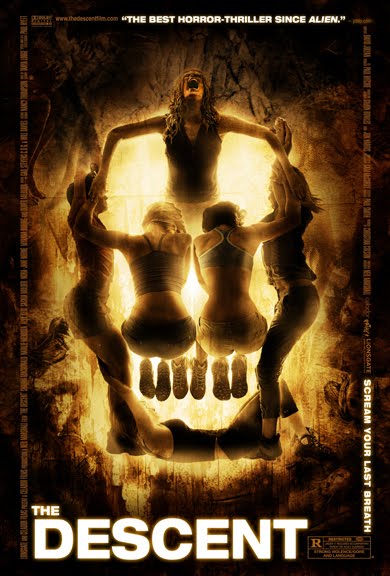
The Descent (2005)
UK --- horror

Dir: Neil Marshall

The heyday of British horror has long since passed, and I’m not really sure what they find interesting anymore other than romantic comedies, period pieces, and taut crime thrillers. I do know that they’ve never really been masters of the genre, outside of the Hammer films and the Amicus anthologies. Let there be no doubt, they are master thespians, but getting down and dirty into exploitative horror, was never really their forte. That being said, I found “The Descent” pretty scary, as the viewer quite literally gradually descends with the characters into the depths of horror.

The story focuses on Sarah as she and her outdoorsy adventuresome friends enjoy stuff like white-water rafting and spelunking. It’s returning from one of these trips that Sarah is in a deadly car accident with her husband and daughter; she ends up being the only survivor. To get her back into living and enjoying life, her friends plan another outdoor getaway in the Appalachian Mountains in the good ole’ US of A. Her friends don’t necessarily consist of the formula Facts of Life/Golden Girls set with a spunky butch chick, a sexpot, a stoic leader, and a complete ditz, but somehow I still got that feeling the character types were there, just underneath their brazen exterior. The one element that is thrown in for good storytelling is a traitor, pointing to an Asiatic mixed girl named Juno who seems is revealed to our heroine as someone who cheated with her husband. The trip inside the Appalachian Mountains is a daring one, as they really don’t know where they’re going, even with a map it’s unclear if anyone ever got out alive. But they’re professionals, and they give it a shot. The only thing they didn’t count on was a race of subterranean mole-like creatures, which actually look more human than anything else. They quickly remind any comic book fan of the Fantastic Four’s enemy The Mole Man, particularly his canon fodder.

Underground landslides eventually separate the group. One by one, the groups are mercilessly killed by the humanoid like mole creatures. Sarah, however plays possum in a pool of blood and bones from past victims. The film leads us to find some revelations about Sarah’s relationship with her friends particularly Juno who not only cheated with Sarah’s husband, but accidentally kills one of their friends underground and leaves her for dead. When Sarah finds the friend, she tells her the truth of Juno, and Sarah stealthily makes her way out of the tunnels, finding Juno in her path. But there’s very little time for soap opera revenge, as the mole creatures are hunting them down. But Sarah wounds Juno’s leg for poetic justice purposes. Now the film has two different endings, one where after fending off the creatures that are tailing her, she makes it to sunlight, and escapes. The other, is the same, only she wakes up in the caverns as we realize it was only a dream.

Director Neil Marshall has a visceral style to his filmmaking in this one, and a proven achievement in lighting with the use of very little light at all. Not only that, but the scenes with the creatures are fast-paced and action-oriented complete with gore and brutal knockdown drag’em out fights. Though the women of course are just no match for the mole men. The suspense builds in this claustrophobic film as we know something bad is going to happen, but not sure what. When we finally are revealed the lurking menace in the caverns, much like the girls in the film, we are genuinely frightened. The interesting aspect of the film tends to want to get the main character Sarah down to a very primal and scary level of human. She in a sense is broken down to an instinct-using creature just like the ones hunting her. It makes for great contrast in the end, as most horror movies tend to make women seem helpless and yet give them power through means of innocence, or ambivalent virginity against evil, this one gets the woman right down at the same level as her predator going toe-to-toe till the end.