Showing posts with label anthology. Show all posts

Friday, February 18, 2011


Heavy Metal (1981)
CANADA
--- science fiction/ fantasy/ horror

Dir: Gerald Potterton

Fond memories of teenage years (though I wasn't one when this was released), "Heavy Metal" is a cult classic of the highest proportions. It is at once a collaborative, rebellious, raucous work of art toiled over a span of years and countries. For many an American GenX teenager, "Heavy Metal" holds an interesting fond place in our hearts. It was made in a time where animation was deliberately taking risks with more adult fare in cinemas like Ralph Bakshi's x-rated "Fritz the Cat", the dark age of Disney films, even "Transformers: The Movie" dared to kill off Optimus Prime.

National Lampoon magazine had bought North American distribution rights to a French magazine named Métal Hurlant ( translated roughly "screaming metal"). Renamed Heavy Metal, the magazine started in the 1970s and blended everything from dark fantasy, horror, science fiction, and oh yes erotica. Artists from all over the globe contributed their own stories and artwork such as H.R. Giger, Richard Corben, Moebius, and many many more. At this time, National Lampoon magazine saw the success on the big screen with a spinoff film "National Lampoon's Animal House" and it wasn't long before the idea to make a film based on Heavy Metal came to fruition. Produced by Canadian filmmaker Ivan Reitman, the film was to be animated by artists from France, Canada, the United States. The idea to make the film an anthology cemented the highly collaborative and unique hodgepodge style of Heavy Metal Magazine, as they adapt popular strips from that were featured in the magazine, as well as creating some new stories.

The title sequence opens with a story by late screenwriter Dan O'Bannon called "Soft Landing" which shows us an astronaut descending to earth in a 1960 corvette. This basically bridges the titles to the framing story of the film "Grimaldi", where we find the identity of the astronaut as Grimaldi coming home to his young daughter. He's also brought home a glowing green orb in a box. The orb ends up killing the Grimaldi as his daughter looks upon it in fear, just as the orb presents himself as "the sum of all evils." Called the Loc-Nar, the orb begins to show her the following tales in the film.


Based on Spanish artist Juan Giménez's "Harry Canyon", this vignette takes place in a dystopian New York City in the year 2031, focusing on the cynical taxicab driver, Canyon, who narrates. Inspired by a film noir, he reluctantly gets involved with the daughter of a scientist who has unearthed the mysterious Loc-Nar. When he is gunned down by a Casper Gutman-esque gangster, the girl is on the run and Canyon is in the wrong place at the right time. Helping her out, the daughter bargains with Canyon to give the Loc-Nar up to the gangster and split the spoils with him. In the end, Canyon realizes he should've never got involved in the first place. This piece has been highly influential, as you have seen many dystopian futurescapes since, in films such as "Blade Runner" or "The Fifth Element"; they have their genesis here.

The next segment (probably my favorite) is based on Richard Corben's popular strip "Den". Voiced by John Candy, nerdy teen Dan, finds the Loc-Nar and experiments with it for his own personal science project. During a lightning storm this inevitably teleports him to another dimension where he becomes a beefy bald grown man. Now as Den, he espies a group of cultists sacrifice a well-endowed young woman to a god called "Uhluhtc" ("Cthulhu" spelled backwards). After a safe rescue, she tells Den she's in reality Katherine Wells from the British colony of Gibraltar. Soon monster minions of Ard interrupt the couple's sexual acquaintanceship. They are brought to Ard, an effete immortal who puts Katherine in suspended animation and forces Den to steal the Loc-Nar from the Queen who tried to sacrifice Katherine in the first place. Den and Ard's beastly henchmen must infiltrate the Queen's palace and ultimately rescue Katherine. This is actually the second appearance of the character Den in animation. He originally appeared in a 1968 self-produced animated short called "Neverwhere" by creator Richard Corben himself. The backgrounds of this piece live up to the Corben art style, but the art (outside of the gratuitous nudity) don't capture Corben's thick pock oiled art much at all.
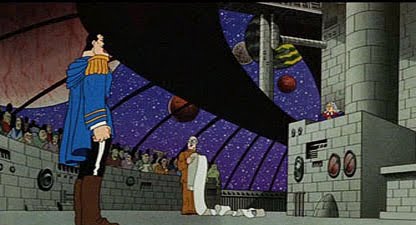
The next vignette is a comedic trip into outer space with Bernie Wrightson's classic ne'erdowell "Captain Sternn". We catch up to Lincoln F. Sternn on trial for a laundry list of violations against the law. Sternn insinuates that his attorney that he has an "angle". That angle turns out to be his witness for the defence, a scrawny guy named Hanover Fiste who soon transforms into a hulking brute who chases after Sternn. Turns out, in the end, Sternn really does have an angle. There was supposed to be a segment between this and the following one called "Neverwhereland" by animator Corny Cole which showed the Loc-nar landing on prehistoric earth and being responsible for all the evils throughout time. This was deleted for time management, but can be seen on the dvd.

"B-17" is basically a short EC Comics style horror tale involving a bomber pilot and his crew, when after perishing in a gun fight, suddenly become undead. This one was written by Dan O'Bannon and was originally to showcase a pilot against gremlins. The next segment is another comedic tale called "So Beautiful, So Dangerous" based on Angus McKie's story which first appeared in the October 1978 issue. This one is about an alien spacecraft abducting humans, and a very sentient robot putting the moves on a woman. This sequence is purely played for laughs before taking us into the final piece.

"Taarna" is an original story based loosely on French artist's Jean 'Moebius' Giraud comic strip "Arzach" which first showed up in the pages of Métal Hurlant in 1974. This tale begins with the Loc-Nar crashing into a volcano. The natives nearby are overcome by the Loc-Nar lava, but are mutated into vicious barbarians and as they go out to destroy a peaceful village. The village elders desperately seek their last refuge in summoning the lone survivor of a warrior race called, the Taarakians. They summon Taarna, a silent beautiful young woman equipped to avenge the peaceful race and seek out and destroy the ruthless mutants responsible. She heads out with her pterodactyl to the mountains to put an end to the mutants tyranny, and comes face to face with the source of the evil; the Loc-Nar. The film ultimately ties up with the revelation that this whole frame story with Grimaldi's daughter is tied to Taarna.

"Heavy Metal" is really an animated adult fantasy to end all adult fantasies. There really hasn't been any equal, and more than likely, will never be. Though a sequel was made years later, it still lacked the brash vision of this film. The fantastic score is provided by the legendary Elmer Bernstein, in what many of his fans proclaim is actually the absolute finest film score he ever did. The needle-dropped soundtrack is anything but in the genre of heavy metal, but peppered with soft rock and prog rock performers. The only real metal in the film is from Black Sabbath. Overseen by Ivan Reitman, you can see his influence throughout the film. Besides hiring composer, Elmer Bernstein, he made sure plenty of Second City performers got work in this. Not just in voice acting, but it almost seems the visuals were inspired by performers like Martin Short, Eugene Levy, and Harold Ramis. For further confirmation watch a double feature of this film and "Ghostbusters" back-to-back and view the similarities, especially in the climatic cityhall scene of GB and the press conference scene in the segment "So Beautiful, So Deadly". Currently, there is a live-action Métal Hurlant tv series airing in France apparently under the name "Metal Howling" or "Heavy Metal Chronicles". News also confirms that directors David Fincher, James Cameron, and Guillermo Del Toro plan to produce a new live action anthology film.

Friday, October 1, 2010


The Vault of Horror (1973)
UK --- horror

Dir: Roy Ward Baker

"The Vault of Horror" comic series was created as a companion piece to "Tales From the Crypt" and "The Haunt of Fear". Most would think that these comics are as interchangeable as Lego's, but this was not the case. Max Gaines and co. made sure each series had a distinct difference. In the case of "The Vault of Horror", Johnny Craig was the cover artist as well as frequent writer throughout the entire run. The series would in a way have his style, which meant the stories often dealt with psychological terrors. In that regard, "The Vault of Horror" film gets kudos, as a well done adaptation.

As a follow-up to the "Tales From the Crypt" anthology, Amicus studios solicited the use of EC Comics title, "The Vault of Horror". This film is the less gorier of the two, and the tales used in this one, while unique are not quite on par with the stories from "Tales". We have the same formula as "Tales" in this film, where a group of people (this time all men) are gathered together and do not know where they are yet, but recite their tales of their own deaths. The aforementioned psychological aspect comes in here, as they each claim to have recurring dreams or fears. There is no vault keeper in this one, I suppose Sir Laurence Olivier was busy. Kidding.

The first tale stars siblings Anna and Daniel Massey as the brother unfolds his recurring dream/nightmare. Adapted from "Tales from the Crypt" #35, "Midnight Mess" features a conniving brother who is in search of his long lost sister. He has hired a private detective to find her, and after getting her location, he kills the p.i. to cover his tracks. He is, of course, another perfect foil for a story like this. The brother travels to what the p.i. felt was a strange town. He does find his sister and after he reveals that their rich father has died and left everything to her, he subsequently stabs her to death. He goes to a local restaurant for something to eat, and discovers the local habitue are blood sucking vampires. To confirm it, his sister, whom he just murdered, walks in with the murder weapon as the hungry diners have their fresh taste of her brother.

The next story is a darkly comic cautionary tale. It involves an overbearing controlling husband with a bad case of OCD, and his slightly younger timid new wife. The vignette plays like an episode of "I Love Lucy" as the new wife has to adjust to her husband's obsessive demands about life around the house. It gets to the point (no pun intended), that she offs him, and neatly stores away his body parts in labeled jars. Based on a story adapted from "Shock SuspenStories" # 1, "The Neat Job" was another one that was remade in the HBO series as "Collection Completed" by Mary Lambert. The difference between the two being the wife in the film version is very much the victim of her husbands ways, in the TV version, she's the cause and culprit. Personally, though it does give the film variety, the film could do without this particular story, as it seems all the men in the vault were villains who truly belonged there.


In the third tale, we get a different type of married couple. A magician and his wife are on vacation in India when he cruelly exposes the poor street magicians tricks. He later happens upon a young lady performing the Indian rope trick, but she will not sell him the secret. He begs her to at least show his sick wife, but he has other plans. The couple murder the girl in cold blood, and they attempt to uncover the riddle behind the magical rope. The wife tries the rope on for size and climbs on up to the ceiling on it, as she vanishes into thin air. Her blood, however, begins to seep out of the ceiling and the husband promptly tries to escape the room, but the rope snaps at him like a bullwhip. Having him trapped, the sentient rope soon entangles around his neck enough to raise him up off his feet to his demise.

The next tale is quite quick, but it also involves a lot of double crossing and twists. We learn that a writer with the assistance of who is presumably his editor devise a plot to inherit his insurance money. He plans to take a drug that will allow his body to appear to all dead. Then after his burial, his friend Alex is supposed to dig him up within 24 hours. All perfectly planned, until two local anatomy students, who discover his body, have their own plans for the body. The end result of this story, based on "Bargain in Death" from "Tales From the Crypt" # 28, is everyone gets their just desserts.

In the final tale, Tom Baker (the most recognizable Gen X Doctor Who) portrays an artist out for revenge. After a visit to a voodoo practitioner, he adopts the use of the black magic. Through creative uses of his paintings of his three crooked business partners, he disperses of them, one-by-one. Of course, like most good Crypt tales, no evil deed is left unpunished. In the humble opinion department, I felt Denholm Elliot was criminally underused in this film. Of note, years later he starred in an episode of the television series "Ray Bradbury Theater". The story would have made an interesting little vignette in a film this, considering Bradbury allowed many of his stories adapted into EC fare, including this one. Having said that, this particular tale comes off as an episode of "The Night Gallery".


The film ends on a dull note, as the men walk out of the "vault" to the graveyard and disappear to their own graves. As one stays behind to explain that every night they must recall their most horrendous acts of the life they lived. It would have been interesting if they had made a nice little trilogy by adapting some more stories for "Haunt of Fear", but alas . . .

Thursday, October 29, 2009


Tales From the Crypt (1972)
UK --- horror

Dir: Freddie Francis

Had it not been for William Gaines’ EC Comics, the world would have no Alfred E. Newman, no crypt keeper, and and especially no Tales From the Crypt. The comic book horror anthology started in 1950, but only lasted till 1955 publishing 30 issues in total. It was filled with ghastly stories often about vengeance beyond the grave or twist endings that end in horror. The comic book featured art by the likes of Al Feldstein, Jack Kamen, Jack Davis, Johnny Craig, and many more. Each artist eventually had their own style to what kind of story they were telling. Gaines found that the hit comic originally called “The Crypt of Terror” should have sister publications such as “The Vault of Horror” and “The Haunt of Fear”. The comic book series was eventually attacked by censors who had followed guidelines of a controversial book titled “Seduction of the Innocent”, that suggested the idea
comic books were ruining children’s minds, and William Gaines’ EC Comics were prime targets. Eventually, censorship were the main killers of “Tales From the Crypt”, as the comic book company folded due to restrictions of the Comics Code.

The legacy of “Tales From the Crypt” was never forgotten. It found it’s most popular resurgence in 1989 with the HBO television series, “Tales From the Crypt” which aired stories more from “The Vault of Horror” than its namesake inspiration. Before that series would ever see the airwaves, the British Amicus Productions made a 1972 horror anthology called “Tales From the Crypt” as well. The film weaved five stories together, with a wraparound. The stories however were not all from the “Tales From the Crypt” comic, but mostly from “The Vault of Horror”. Interestingly enough Amicus would produce a film of that anthology too, serving as a sequel to “Crypt”.

This version of “Tales From the Crypt” also featured a crypt keeper, played by Sir Ralph Richardson who’s dressed like a monk and is sans any ghoul makeup. Directed by Freddie Francis, the synopsis tells of five tourists who go missing from a group in a catacomb. The crypt keeper makes his all too mild mannered appearance when they discover they’re trapped. He begins to unfold upon them stories of their futures. Joan Collins stars in the first story adapted from a story in “The Vault of Horror” #35, “… And All Through the House”. This is probably the most famous and memorable tale from any of the line of comic stories, as Collins portrays a woman who murders her rich old husband on Christmas Eve, only to get a visit from an escaped convict dressed as Santa Claus. The thing about this version of the story (which was also adapted by Robert Zemekis on the HBO series) is Collins portrayal of the bitchy wife. This wife seems the perfect foil for this story; she deserves what’s coming to her, as Zemekis’ heroine is boring. Also this Santa killer is an older frail chap that looks like someone’s crazed old uncle, not the stocky Larry Drake who poses more of a threat. One thing that always bothered me about this story is, the wife makes no attempt to get an alibi and should want to use the Santa killer as an alibi for her husband’s murder. It, in itself could make a good feature length thriller if done right.

The next story is pretty dull as an adulterous husband leaves home and drives away with his mistress. They get in an accident and he awakens to get help, but everyone who lays eyes on him is instantly runs away in fright, even his wife. He finally pays a visit to his mistress when she reveals she was blinded in the very same accident he died in. The story folds back to just before the accident, as all this was just a premonitory dream. This tale actually comes from the comic “Tales From the Crypt” and adapted from “Reflection of Death”. It also bears a slight resemblance to another British horror anthology film “Dead of Night”. The third vignette stars Hammer horror alum Peter Cushing as a fairly eccentric neighbor of a snobby father and son who toy with his emotions. It ultimately leads to his suicide, and of course the son is the first recipient of vengeance from beyond the grave. The fourth tale is based on the famous W.W. Jacobs horror short story “The Monkey’s Paw” as a business man learns he’s lost his money, his wife discovers a Chinese statue and makes a wish for money. The husband dies in a car accident after being chased by a skeleton like figure on a motorcycle. So, she gets his money, regretting her first wish she uses a second wish to wish him back to life just as he was before he died. Her husband does come back to life, but in great pain because he’s already been embalmed. The final tale is another original “Tales From the Crypt” story called “Blind Alleys” and is easily one of the best of the film IMHO. A newly appointed director of a home for the blind deliberately forces unnecessary changes in the place due to financial cutbacks. These cutbacks include no heat, very little amounts of food and a change in that quality of food, while the new director and his pet German Shepard seem to be having the time of his life at the blind patrons expense. The residents decide to seek vengeance in their own way, building a small labyrinth in the basement and forcing the new director to traverse through with razor blades affixed to the walls of a narrow corridor. Meanwhile, the best surprise is left for last as the director’s dog is starved for hours on the other side of that corridor, as the residents make him a blind man by flicking the lights off in the labyrinth and releasing the dog.

The wraparound tale ends with the crypt keeper revealing to the tourists that premonitions were actually the reasons why they were there. As a cave opens to a white light and they discover they are in eternal damnation. Amicus made a style of producing quality anthology horror films, and this one remains one of their best, if not one of the best of the genre period. It would come to inspire followers like Creepshow and many other horror anthology films. Alls well, that ends well.