Friday, February 11, 2011


The Descent (2005)
UK --- horror

Dir: Neil Marshall

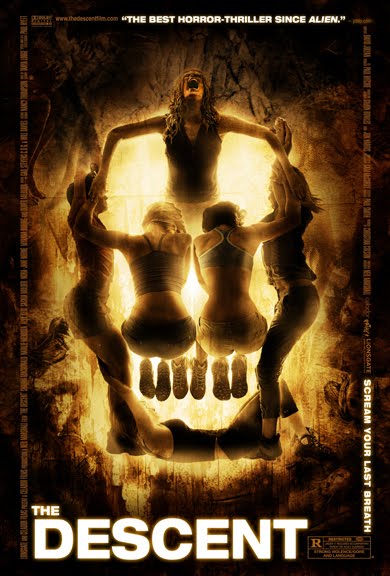
The heyday of British horror has long since passed, and I’m not really sure what they find interesting anymore other than romantic comedies, period pieces, and taut crime thrillers. I do know that they’ve never really been masters of the genre, outside of the Hammer films and the Amicus anthologies. Let there be no doubt, they are master thespians, but getting down and dirty into exploitative horror, was never really their forte. That being said, I found “The Descent” pretty scary, as the viewer quite literally gradually descends with the characters into the depths of horror.

The story focuses on Sarah as she and her outdoorsy adventuresome friends enjoy stuff like white-water rafting and spelunking. It’s returning from one of these trips that Sarah is in a deadly car accident with her husband and daughter; she ends up being the only survivor. To get her back into living and enjoying life, her friends plan another outdoor getaway in the Appalachian Mountains in the good ole’ US of A. Her friends don’t necessarily consist of the formula Facts of Life/Golden Girls set with a spunky butch chick, a sexpot, a stoic leader, and a complete ditz, but somehow I still got that feeling the character types were there, just underneath their brazen exterior. The one element that is thrown in for good storytelling is a traitor, pointing to an Asiatic mixed girl named Juno who seems is revealed to our heroine as someone who cheated with her husband. The trip inside the Appalachian Mountains is a daring one, as they really don’t know where they’re going, even with a map it’s unclear if anyone ever got out alive. But they’re professionals, and they give it a shot. The only thing they didn’t count on was a race of subterranean mole-like creatures, which actually look more human than anything else. They quickly remind any comic book fan of the Fantastic Four’s enemy The Mole Man, particularly his canon fodder.

Underground landslides eventually separate the group. One by one, the groups are mercilessly killed by the humanoid like mole creatures. Sarah, however plays possum in a pool of blood and bones from past victims. The film leads us to find some revelations about Sarah’s relationship with her friends particularly Juno who not only cheated with Sarah’s husband, but accidentally kills one of their friends underground and leaves her for dead. When Sarah finds the friend, she tells her the truth of Juno, and Sarah stealthily makes her way out of the tunnels, finding Juno in her path. But there’s very little time for soap opera revenge, as the mole creatures are hunting them down. But Sarah wounds Juno’s leg for poetic justice purposes. Now the film has two different endings, one where after fending off the creatures that are tailing her, she makes it to sunlight, and escapes. The other, is the same, only she wakes up in the caverns as we realize it was only a dream.

Director Neil Marshall has a visceral style to his filmmaking in this one, and a proven achievement in lighting with the use of very little light at all. Not only that, but the scenes with the creatures are fast-paced and action-oriented complete with gore and brutal knockdown drag’em out fights. Though the women of course are just no match for the mole men. The suspense builds in this claustrophobic film as we know something bad is going to happen, but not sure what. When we finally are revealed the lurking menace in the caverns, much like the girls in the film, we are genuinely frightened. The interesting aspect of the film tends to want to get the main character Sarah down to a very primal and scary level of human. She in a sense is broken down to an instinct-using creature just like the ones hunting her. It makes for great contrast in the end, as most horror movies tend to make women seem helpless and yet give them power through means of innocence, or ambivalent virginity against evil, this one gets the woman right down at the same level as her predator going toe-to-toe till the end.

Friday, February 4, 2011


Gulliver's Travels (1996)
UK/USA --- fantasy

Dir: Charles Sturridge

Never has a novel dared to look so close into the nature of mankind with an unflinching depiction of our inward being. Renown Irish satirist and clergyman, Jonathan Swift, placed a great mirror in front of 18th century society and dared everyone who would read his 1726 novel "Gulliver's Travels" to ask themselves the question "Who am I?". While this classic tale has been filmed on more than several occasions, it has almost always focused on one or both of the first two chapters of the novel being "A Voyage to Lilliput" and "A Voyage to Brobdingnag". The most famous version being the Fleischer's animated film in 1939. It wasn't until this 1996 television mini-series that Swift's fully realized vision came to screen with an appropriate international cast and note-worthy special effects.

A co-production of the UK's Channel 4 Television Corporation and America's Hallmark, Jim Henson Productions, and RHI Entertainment Inc, "Gulliver's Travels" stars Ted Danson (coming off of his long stint on the tv series Cheers) as Dr. Lemuel Gulliver. A man, due to financial burden decided to take his practice out to sea. Told in flashback, Gulliver returns to his home after nine years to his wife and young son. Unfortunately, the house has been purchased by a Dr. Bates who has allowed Mrs. Gulliver (played by Danson's real life wife Mary Steenburgen) to stay in the home to keep up housekeeping duties. They find Dr. Gulliver in the barn, as we learn that his strange voyage began with a shipwreck, which apparently landed him on the shores of a land called Lilliput. It just so happens however, Lilliput is entirely populated by human beings who are less than 6 inches high. A father and son discover Gulliver like a beached whale, and soon the military come in droves and bind him for safety. The loopy emperor (played perfectly by Peter O'Toole) welcomes the giant oddity with open arms, as he prizes him as not only an asset of fortune but of war. An almost nonsensical war at that, disputing over which side to break eggs on the little ends or big ends. When they feel they can longer control Gulliver, the Lilliputian military plot to kill him, setting him to flee and find refuge in another land. Meanwhile, Dr. Bates finds Gulliver's regaling of his adventure incorrigible and tiresome and has him committed to a local asylu; namely the infamous Bedlam.

Gulliver then recalls finding land again, this time in a land of giants, where it is he who is tiny and the giants are estimated (according to the novel) to be 72 feet tall. He is found by a farmer and is all too quick to profit from his new discovery as well. The farmer and his family use Gulliver as an oracle of the fields, until he comes to the attention of the Queen of Brobdingnag, who desires to have him for herself. The Queen invites the farmers daughter, Glumdalclitch, as Gulliver's nurse and her royal court marvels at the diminutive Gulliver. She even has a small "doll" house built for him. Her medical physicians poke and prod at him, while he assures them all the while that he is indeed human. The Queen's admiration of Gulliver comes to the quick dismissal of her former dwarf jester (Warwick Davis), and he spends his time trying to get rid of his replacement. Gulliver, however, has a hard time trying to convince the queen that his home in England is a civilized society. This film's version of Brobdingnag has no King, but their conversation of England carries over into this film. By comparison, Brobdingnag seems almost Utopian in nature, and casts Gulliver's descriptions of England's ruling class to be primitive. After evading a provoked battle with a bunch of wasps thanks to the Queen's former jester, eventually, Gulliver conjures up a way to please the Queen by giving her a firsthand demonstration of the practical use of gunpowder. When things literally blow up in their faces, Gulliver becomes dismayed, but is once again spirited away to another land. This time, a bird takes the box he's in and drops him out in the ocean.


The next chapter picks up with Gulliver being rescued by citizens of the floating island of Laputa. Powered and controlled by a giant magnetic lodestone, the hovering island is inhabited by male-dominated flighty intellectuals and dignitaries. Though they study astronomy, mathematics, and technology, they lack basic common sense. In fact, the Rajah of Laputa wars against his wife the empress Munodi (played by Geraldine Chaplin) on land when she refuses to send up brain taxes (food). The film version gives Laputa citizens an Indian/Middle Eastern ethnicity. When the empress disrupts the lodestone by counteracting it with her own magnet pulled by horses, it sends Laputa adrift and trying to help, Gulliver himself falls down to land. He meets with the empress and in their discussion learns of the Academy; an irresponsible collective of thinkers who have total disregard for the rest of the world. Gulliver leaves for the Academy in hopes to find directions home, but only finds more mad scientists so engrossed with their own strange experiments they care nothing of the real world. When Gulliver realizes he won't find any answers there, he leaves and is out in the desolate outskirts when he is picked up by a good Samaritan named Glubbdubdrib, (played by Omar Sharif) who offers him shelter and a ride out to the port where a Dutch ship is set to sail. Gulliver's stay at Glubbdubdrib becomes a little bit of a detour as he learns he has been drugged for days and used by Glubbdubdrib for his blood to resurrect historical figures from an enchanted mirror. Soon, he manages to escape the sorcerer's estate and continue on his journey, but he is captured by soldiers of the immortal struldbrugs. Once there, they invite him in after he offers the giant wasp stinger as a gift. They offer him a drink from their fountain claiming it will retain his youth and he too will be immortal. The one problem he discovers is that they are all blind. He manages to escape once again, making it to a ship bound for sea.

The final voyage is the most controversial and thought-provoking, as Gulliver arrives on the island of the Houyhnhnms (possible anagram for "you humans" and phonetically sounding like "whinny"). The Houyhnhnms are a race of intelligent horses who rule over a race of barbaric humans called Yahoo's. He converses with one of the Houynhnhnms, named Mistress, who goes on to explain to him the rituals and habits of the Yahoo's, while Gulliver once again tries to explain and not necessarily justify aspects of his society; such as wearing clothes. Gulliver spends most of his time learning the ways of the Houynhnhnms and growing ever so seduced by their culture, to the point of hating himself for falling short of his own human nature. Ultimately, the Hounyhnhnms begin to suspect that Gulliver is really no different from the Yahoo's and decide to banish him from the island. It is this section where Swift is accused of being an out-and-out misanthrope.

For anyone who has read the novel "Gulliver's Travel's" and is not so clingy to it with the attitude that a film can't do justice to it, I think they will find this film to be a pleasant tribute to Swift's tale. The tone of the film does go too far into the comedic direction rather than the satiric approach which the book took. Though that can be like walking a tightrope. The performances from most of the cast is top notch, and Danson's voice over firmly allows the audience that leeway of satire, as his credible inflections often feel like that from a man who speaks with authority. A great thanks goes to him for not attempting an English accent.

The film has taken more than it's fair share of liberties. The major addition of a parallel framing story of Gulliver being committed to an asylum is actually noteworthy for a couple of reasons. One, it is fitting that this book written in a time of Munchhausen and Quixote, lacks that fidelity of questioning sanity. Especially since Jonathan Swift himself became a strong advocate of the mentally ill, going so far to leaving his entire estate to Ireland's first Mental Institituion. Two, the nature of the book jumps from one place to the next haphazardly, and doesn't work all that well for film.

Swift's tale is one of great thought and reflection on religion, politics, and human beings in general. The aspect of lost societies was fairly popular and disputed in the time of "Gulliver's Travels" publication. Legends of lost continents have survived for centuries such as those of Mu, Lemuria, and the infamous Atlantis, as well mythical lands such as El Dorado or Shangri-La. His use of language is also interesting, as the common theme seems to give all of these societies and people names that rhyme with "drudgery". Even the hovering island of Laputa is a Spanish curse word.


Overall, this version of "Gulliver's Travel's" is going to be difficult to top. The CGI effects in this production is acceptable for its time, and manages to hold up thanks in part to the storytelling and aforementioned performances. Jim Henson's creature shop provided the animatronic giant wasp and some of the settings like Laputa. The sweeping score provided by Trevor Jones, thoroughly memorable as with most of his scores. If you love this classic tale, this is the one not to miss.

Friday, January 28, 2011


Mad Max (1979)
AUSTRALIA
--- science fiction

Dir: George Miller

Dystopian futures are an easy sell for audiences. They are the one of the best uses of the science fiction genre, as a signpost to the dangers of not only where society is, but where we are headed. Within this sub genre we've had classics. Coming out of the 60's where threat of nuclear war was as imminent as visible storm clouds on the horizon, many filmmakers steered clear of the Totalitarian or Communist messages (such as "Alphaville", "Logan's Run", or "THX 1138") and more toward a believable future oblivion. These futuristic visions would spotlight a decayed complete collapse of any structure whatsoever. George Miller's "Mad Max" begins here.

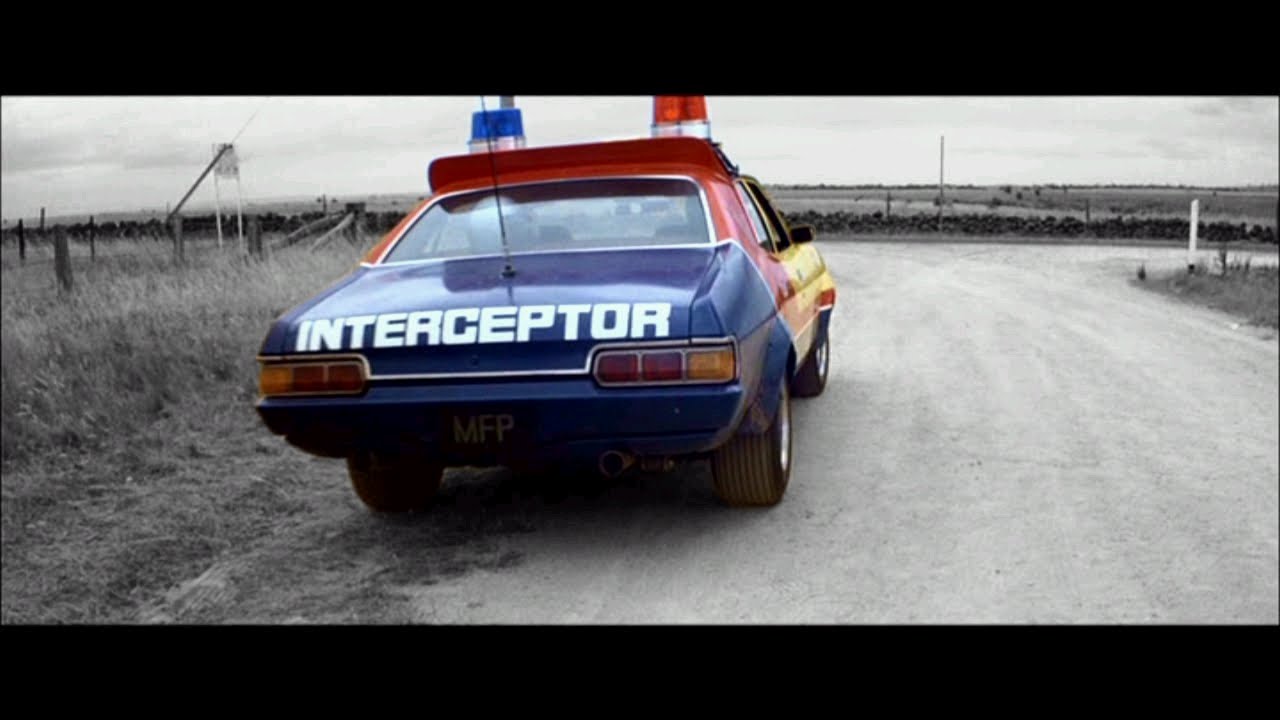
The "Mad Max" trilogy (soon to be expanded with a sequel) has the unique distinction of chronicling the decay of a society. This first film is simply dystopian future of specific date, where outlaw biker gangs and psychopathic drivers roam free on the highways of Australia. The police force, while seemingly sparse, still manages to enforce law and order. Our introduction to this bleak future is through a patrol car tasked to take down a violent AC/DC-quoting driver who calls himself "The Nightrider"; a character straight out of a Carsploitation film. When the patrol vehicle is totalled during a harrowing high speed chase, the hero of our tale emerges; Max Rockatansky (played by a young and relatively unknown Mel Gibson). His Main Force Patrol vehicle appears to be a standard yellow, blue, and red, but the other vehicle had a code emblem of PURSUIT, and Max's has one V8 INTERCEPTOR (a converted Ford Falcon). This is the same vehicle that will turn up in the sequel, except it will be painted black, much like the "Nightrider".

"Nightrider" doesn't turn out to be much of a threat when Max catches up to him and his girl. They end up crashing and destroying their vehicle, and Max is saluted for his fine job of taking out the maniac. We're taken to Max's home life where we see he's a new father. It also is apparent he's a reluctant hero, who isn't so comfortable in his celebrity status. Soon we're also shown Max's car in the shop, being prepped by a mechanic to suped-up capabilities. Also, the politics from the insides of the "Halls of Justice" don't really even care to celebrate Max's contribution to the force, as we learn that isn't prone to staying a cop. Max's superior informs him a new foe has emerged from the "Nightrider"s death, when a biker named "Toecutter" (played to the hilt by a convincing Hugh-Keays Byrne) rears his ugly head with his gang in tow. They just as soon declare vengeance against Max and the rest of the MFP. To cement their threat, the gang molest a young couple outside of town and Max and his partner biker The Goose get called to respond. The damage is done and the gang is long gone, but they leave a one of their own behind, in a delirious Johnny the Boy spouting the same insane rhetoric about "Nightrider", allowing Max and The Goose to put two-and-two together.


They arrest Johnny the Boy, but after having him locked up in the shanty headquarters of their police station for awhile, the bureaucratic system releases him when no one shows for his trial. The Goose gets irate over this mockery of justice, and wants to take Johnny the Boy apart himself. The officers, still in disbelief watch as he is set free on the streets, but their superior allows them the officers to do whatever necessary so long as it's on paper. We soon see as Johnny the Boy returns to "Toecutter", he has to pay for his release, with the blood of one of the officers. So Johnny the Boy is coerced to go after the Main Force Patrol, and he targets The Goose. When The Goose is burnt alive and left for dead, Max goes on a temporary sabbatical in the country with his family. They enjoy the open freeway and head toward the beach where they visit with a family member. Unfortunately the solace is cut short when the "Toecutter"'s gang harrass Max's wife and child, and later hunt her down ultimately killing both. Driven to madness, Max takes matters into his own hands, taking his new INCEPTOR out of the shop and hitting the road with only one thing in mind . . . revenge.

Filmed on the very desolate outskirts of Melbourne, Australia, "Mad Max" is a film that came at a time in the Seventies when cinema was all about exploitation of all kinds. They ramped up sex and violence, and skewed toward fetish-esque niche markets like Blaxploitation, slasher films, revenge epics, carsploitation films, you name it. Mad Max fits in a couple of those sub genres quite nicely. The score was supplied by composer Brian May, that effectively amps you up with the roar of the engines and screeching of tires. It became a hallmark of Australian cinema. In the end film is a dark commentary on the anxiety of the late Seventies and the changing cynical outlook of our future. Borrowing from the influence of George Lucas' uber-successful "Star Wars", with the use of Joseph Campbell's 'Hero With A Thousand Faces' (as well as the swipe transitions in editing), Miller creates a new mythological hero in Max. Having placed a broken man in an equally broken society. With a dystopian landscape, Miller would soon help pave the way for the next decade in a slew of post-apocalyptic films, that were not only inspired by this film, but its sequel.

Friday, January 21, 2011


Kansen (Infection) (2004)
JAPAN --- horror

Dir: Masayuki Ochiai

This film plays somewhere between your typical gross-out J-horror and a morality tale. The morality being, always tell the truth, as malpractice will always catch up with you. I suspect this film to be a social commentary on the Japanese healthcare system. "Kansen" takes place in a sort of out-of-the-way, short-staffed hospital. For the first hour or so, we are introduced to all the main characters. It often feels like a boring medical drama in the style of "ER" or "Grey's Anatomy", luckily, the horror elements do kick in. First off, with a suspicious elderly woman who claims to see dead people in reflective surfaces. The real horror begins, however, when an ambulance tries to press a patient with a peculiar rash, on the hospital.

Dr. Akiba refuses, claiming the hospital simply cannot care for him due to the fact they do not have the proper facilities. Akiba rushes to a critical patient upstairs in room #3. The patient falls unconscious and the responding staff fear losing him. Akiba then calls for potassium calcium chloride (which is used in lethal injections to stop the heart) instead of calcium chlorate. In other words they misdiagnose, and the patient ends up dying on them.

The doctors and two other nurses plot to cover-up for the accidental death, and it is from here on out that the green ooze begins to infect the main staff randomly. It is unfortunate that the remainder of "Kansen"s plot is scattershot. While that may work for some films, this has too many subplots and characters to deal with, and resulting in no real solution. Sure, it does tie up character arcs, but you end up feeling an empty loss for the events of the film as they pull you every which way but loose. Director Ochiai does a decent job attempting to balance the film, through use of color themes and freaky camera angles. Beyond that, I can't recommend much here.

"Kansen" was billed as the inaugural release of a proposed 6-part J-Horror film series, from producer Takashige Ichise. One original entry from a different director each time. Unfortunately, it would appear we only got three of those, including this film "Yogen" (Premonition), and "Sakebi" (Retribution).

Fortunately, it would seem the other planned directors made their films anyway, they just didn't include it under the banner of this J-Horror film series. As of this writing, I have not seen all of them, though from what I've seen they all share a similar mind-bending climax. Unfortunately none of the films are highly original in any way, as they were simply conceived to cash-in on the Japanese horror fade quickly.

Friday, January 14, 2011


Hercule et la Reine de Lydie (Hercules Unchained or Hercules and the Queen of Lydia) (1959)
ITALY/ SPAIN --- fantasy

Dir: Pietro Francisci

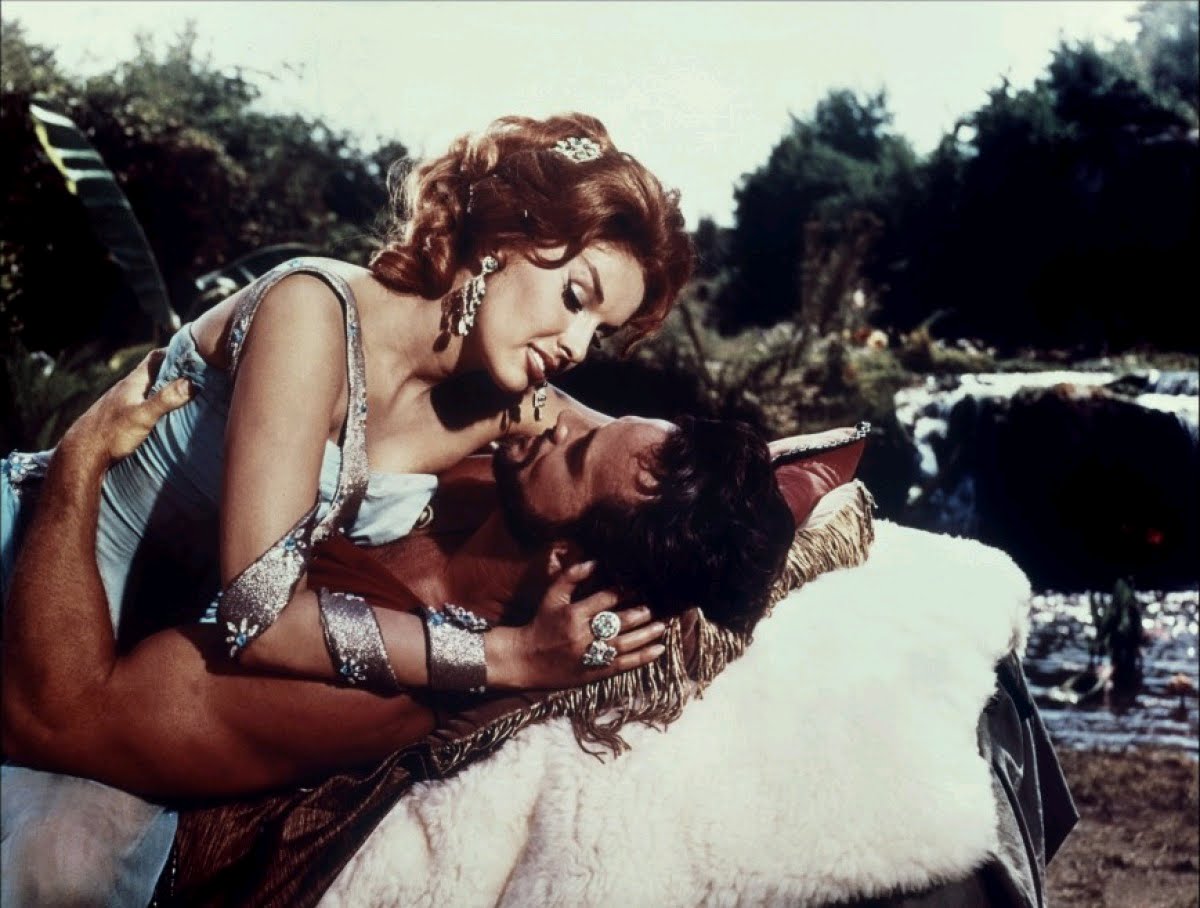
In this direct follow-up to the 1958 film "Hercules", Steve Reeves returns for his second and final portrayal as the mythological muscleman Hercules. Also returning is the beautiful Sylva Koscina as Hercules' now wife Iole and Gabriel Antonini playing a young Ulysses. We catch up with the trio on a horse-drawn chariot en route to Thebes. They soon run into danger, when an arrogant brute harasses them with intent. Confronted by Hercules, they realize their tormentor is more than meet the eyes as Ulysses councils Herc that he may be Antaeus son of the Earth goddess. His defeat must come by his separation from solid ground, so Herc tosses him in a body of water nearby.

When they arrive in Thebes, Hercules finds the blind king Oedipus prepared for death. He has been dethroned by his two sons Eteocles and Polynieces, who agreed to switch off duties annually, but that agreement has soured as both plot to destroy each other by any means necessary. Hercules willing plans to intercede for the brothers in an attempt to restore peace on the land. His good intentions, however, are interrupted as he leaves Iole behind with Eteocles' camp to serve as messenger with Ulysses. En route, Hercules drinks from the waters of Lethe (one of the of the five rivers of Hades, being the river of forgetfulness), and is seduced by what sounds like Iole singing. He is lured to a ravine where he passes out, but Ulysses finds he is surrounded by soldiers. He wisely plays the part of the deaf mute, as they are captured.

The soldiers bring Hercules and Ulysses to the beautiful sorceress queen Omphale (played by French model Sylvia Lopez). When Herc awakens, he finds himself surrounded by a bevy of female servants and the queen swimming. He asks of Omphale his identity, as she tells him that he is king of the land and that she is his bride. Soon, Ulysses must help Hercules restore his memory before Omphale has him killed, by way of suspended animation. To make matters worse, the warring brothers are preparing to strike and the populace of Thebes are growing restless. Sending word for help by carrier pigeon, Ulysses finally does pull Herc out of the grasp of Omphale, with the help of the Argonauts. After they escape, Hercules and the group must get back to Thebes, and rescue Iole before bloodshed erupts.

"Hercules Unchained" is loosely based on the Aeschylus' "The Seven Against Thebes" as well as other various Grecian myths. Let me be honest with you. Of all the countries in the world to have a operating film industry, Italian cinema are on the bottom rung for me. The very fact that they refuse to record on set sound as a collective stylistic choice and most of their films are cheap ripoffs of Hollywood fare is just baffling to me. Having said that, all of this has its expected charms. Spaghetti westerns is a favorite sub genre of myself and many others, and I like even some of the esoteric films that most would not sit through. These Sword & Sandal epics are in the same boat. An good-looking imported American lead actor, a convoluted plot, and lots of action. That pretty much sums up Italian cinema in my opinion.

The cinematography of Mario Bava allows the viewer some eye candy besides the oiled-up men and scantily clad women. The musical interludes makes the film feel very dated and the dance sequences are pretty much designed for a popcorn/restroom break. Costumes and production design in general are once again admirable, and given the source material and locale, it should be. Unfortunately, as it goes for these films, this is top notch. Steer clear if your not an aficionado of Italian cinema, Greek mythology, or just plain old MST3K style films on a lazy Saturday afternoon.

Friday, January 7, 2011


A Clockwork Orange (1971)
UK
--- science fiction

Dir: Stanley Kubrick

Never has the future looked so creepy, bleak, and in hindsight unnervingly believable but it's a far cry from apocalyptic. Though, in some scenarios, other people can be considerably worse than no people. Based on the controversial 1962 novella by Anthony Burgess, "A Clockwork Orange" certainly set the standard for dystopian films. The novel and the film pose the question of what exactly is freewill? How can one judge another human being when we all have fallen from certain subjective morals? Taking a long dark look into the iris of our collective youth, this masterpiece from director Stanley Kubrick, continues to be an alarm clock to society.

Taking place in the near-future in England, the film focuses on teenage juvenile delinquent Alex DeLarge, (played by a young and blankly sinister Malcolm McDowell) who leads a gang called "droogs" that goes terrorizing upper class citizens. They do not go to any formal kind of school and adorned in white rugby suits, black bowlers and canes, they spend most of their time drinking "milk plus" (a concoction of milk mixed with drugs) at the Korova Milk Bar, brutally torturing or molesting random innocent people. With a penchant for Ludwig Von Beethoven and violent carousing, Alex is a classified menace to society, but he isn't alone. Alex and his "droogs" also get into fights with other gangs. Alex and his "droogs" partake in what we would now legally classify as "Home invasion" on an older couple brutally beating the husband and raping his wife.

Later, Alex uncovers dissension in his group of "droogs", and takes care of the rabble-rousers himself in an alpha-male effort to regain control of the gang. They decide to go out for another night of harassment and mark an older woman's home. Alex is the one who breaks into the flat solo, and beats the woman to death with a large sculpture of a penis. He frantically escapes at the sound of sirens and and makes it outside to his gang of "droogs", who turn on him by knocking him upside the head with a bottle of milk. Alex is taken into the authorities. Here, he is informed by his probation officer that the woman died, and that he's going to serve time. Off to the prison Alex goes.


In prison he is forced to read and learn the bible and sings Christian songs along with the other unrepentant inmates, but Alex begins to feel he needs more. When questioned by Alex on how to go further in repentance, the chaplain informs him of an experimental scientific process that will rehabilitate him to unconditionally reform himself. He agrees to undergo the state-funded experiment. Submitting to a torturous viewing of violent footage while droplets of a liquid serum are put in his forced-open eyes, Alex does become rehabilitated. Violence completely turns him off, even his favorite Ludwig Von becomes detestable to him. Upon release, Alex is a new man. He also has a dubious celebrity status, as all the news reports of his so-called miraculous government-funded change. The world is a little less believing in him as he is. His family has all but forgotten him, not even keeping his room for him. There's also by chance or happenstance the comedic karma of running into people he once did wrong, like a homeless drunkard he harassed, his old "droogies" who are now bona fide policemen, and one of the victims he crippled. This all leads to a conclusion that surprises us, as Alex appears to once again find himself.


Stanely Kubrick's "A Clockwork Orange" is essentially a gangster film with EC comics sentimentalism. It could easily be shown in a marathon along with "Goodfellas", "Menace to Society", or "Boyz n Hood", and fit right in. Yet the film remains a satiric commentary on societal youth in revolt, and we get the underwhelming feeling the kids will not be alright after all. "A Clockwork Orange"will never go down in history in but a descriptive few words, it ends up allowing the audience to not just be disgusted by the terrible actions of Alex, but the subjugation he submits to under the hands of the governmental scientists. You cannot easily take a side with this film, there ends up being a sympathy for Alex leading up the finale. This parallels the deep discussions we all get into about Capital Punishment and Abortion.

Chock full of Kubrick's painfully beautiful shots and verve of classical music swimming throughout the piece. Malcolm McDowell's unflinching bad boy performance of Alex allows us a no-holds-barred almost documentary peek into this dystopian mindset. Burgess' strange yet credible poppy dialogue may have went on to inspire even Philip K. Dick's "Cityspeak" from "Blade Runner". The future in this film inspired a darker prophecy, with such things as the "punk/goth", "gangsta/hip-hop"movements, and others. The fact is we were warned. As a science fiction film, the film isn't as revolutionary as Kubrick's "2001: A Space Odyssey". He deliberately had a lesser budget and like Godard's "Alphaville", used contemporary beat-up London as a stand-in for a dilapidated future. The technology is far outdated by now, and the production has a strict kinda Sixties futurism design to it. The fact is, if you're looking for all that, you're completely missing the point.

Friday, December 31, 2010


Gui da gui (Encounters of the Spooky Kind) (1980)
HONG KONG --- horror

Dir: Sammo Hung Kam-Bo

It's always somewhat of a gamble to mix horror with comedy and have it turn out successful. Both genres of film are very obtrusive. What may scare or get a laugh from one person, could change completely to the next person. So it has always been kinda difficult to walk that tightrope. Hong Kong films have never had a problem throwing their audiences on an emotional roller coaster. One minute they could be in a suspenseful battle scene, the next they could make you laugh.

"Encounters of the Spooky Kind" (aka Spooky Encounters) is a slight foray into the horror genre, while mixing martial arts with a dash of comedy. Legendary comedic kung-fu star and director Sammo Hung plays his familiar lovable sap, this time named Cheung, or as the townsfolk call him 'Courageous Cheung'. He was so named because of his bravery; but he is soon put to the test. In the opening of the film, we get a dubious introduction to Cheung. In a dream sequence, he's being tormented by two ghosts. He wakes up falling out of bed and to the consistent insults of his wife. Cheung goes out a local restaurant with some friends who want to test his bravery. One of them dares him to go through a variation of the bloody mary urban legend, and a meal is on the line.

Cheung goes to a his friends house at midnight with an apple he's supposed to peel completely in front of a mirror. If he succeeds, he'll have good luck and if he fails he'll be cursed. Things don't turn out right, cause his friends set him up for a prank with one of them dressed as a the ghostly woman that's supposed to appear in the mirror. One of Cheung's friends does indeed see the ghost though, and high tails it out of there. His other friend, the one who put him up to it agree's to get Cheung's next meal, that is until the lady in the mirror pulls him in. Alone now, Cheung is confronted by the ghost and stands to meet the same fate, but narrowly escapes with his life as the house crumbles to the ground.

Cheung retains his rep, but soon has much bigger issues to deal with. He appears to be a chauffeur for a wealthy politician named. Master Tam who only comes to Cheung's village for an extra-marital affair. Cheung has lunch with some friends while getting the hint about infidelity from the local merchant, yet must contend with suspicions of his wife. By chance, he comes across two peeping toms at his window staring at a couple in his house. We see that it is Master Tam with Cheung's wife, who flees the scene of the crime before Cheung busts in on them.

Like the biblical King David, Master Tam goes to sinister lengths to cover up his infidelity. With the advice of an assistant, he plots to kill Cheung, but instead of simple murder, they go the supernatural of using black magic against him. They pay a greedy local taoist sorcerer to do the job, but his younger brother Tsui (played by legendary kung fu star Fat Chung), disapproves of his older brothers intentions, and decides to help the unbeknownst victim; Cheung.

Cheung is set-up again to test his bravery, this time by someone working with the sorcerer. A man follows Cheung and wagers him some money if he sleep overnight in a temple. Tsui is onto them, and goes to Cheung's assistance about what to do to survive the night. After surviving a harrowing battle with a jiang shi or hopping vampire (performed by Hung and Chan contemporary Biao Yuen in heavy makeup) Cheung is met with another wager to sleep in the temple. Tsui of course assists with some weaponry to combat his older brother's magic. Night two proves more difficult as Cheung gets into a physical confrontation against the undead.

He does, however survive again, so Master Tam devises a plan to frame him for the murder of his wife. He's jailed and escapes becoming a fugitive to find out who killed his wife. When he teams with Tsui again, they discover he's been framed by Master Tam and is behind the corrupt sorcerer's intention to kill him. It soon leads them both into an all-out battle of supernatural warfare.

"Encounters of the Spooky Kind" features some pretty decent special effects, and the martial arts expertise of Sammo Hung. The film uses a score that lifts bits of Stanley Kubrick's "The Shining", but that's hardly even an issue once you get into it. Hung definitely holds the balance of kung-fu and comedy pretty tight, but if you're looking for scary horror, you won't find much here. Keep a lookout for "Kung-fu Hustle"s Sui-Lung Leung as one of the peeping tom's.